API-first in 2026: standards, tooling and opportunities
API-first development in 2026: standards, tooling, governance and the opportunities it unlocks for agencies and product teams.
The digital landscape is evolving at an unprecedented pace, and at its core lies the API. For B2B software agencies and startups, embracing an API-first approach is no longer a strategic advantage; it’s a fundamental necessity for survival and growth. As we look towards 2025, the API-first trends are solidifying, pointing towards a future where interconnectedness, developer experience, and intelligent automation are paramount. This article delves into the key shifts in standards, the advancements in tooling, and the burgeoning opportunities that will define the API-first paradigm in the coming year.
The Maturation of API Standards: Towards Greater Interoperability and Security
The foundational elements of API development are undergoing a significant evolution. In 2025, we’ll see a continued push towards more robust and universally adopted standards, fostering seamless interoperability and enhanced security across diverse platforms and ecosystems.
OpenAPI Specification (OAS) as the De Facto Blueprint
The OpenAPI Specification (formerly Swagger) has cemented its position as the industry standard for describing RESTful APIs. In 2025, its adoption will deepen, moving beyond mere documentation to become an integral part of the entire API lifecycle.
- Design-first Development: Expect a stronger emphasis on designing APIs using OAS before writing a single line of code. This “design-first” methodology significantly reduces rework, improves collaboration between development and product teams, and ensures APIs meet business requirements from the outset. Metrics like reduced bug count post-release and faster time-to-market for new features are direct beneficiaries.
- Automated Code Generation: OAS will increasingly drive automated code generation for both server stubs and client SDKs. This not only accelerates development but also ensures consistency and adherence to the defined contract.
- Enhanced Validation and Testing: OAS definitions will be leveraged more extensively for automated request and response validation, improving the reliability and security of API integrations. This can lead to a measurable decrease in integration failure rates.
GraphQL’s Growing Influence in Specific Use Cases
While REST remains dominant, GraphQL will continue to gain traction for specific use cases where its declarative data fetching capabilities offer significant advantages.
- Efficient Data Retrieval: For applications requiring complex and nested data structures, GraphQL’s ability to fetch only the necessary data in a single request can drastically improve performance and reduce over-fetching. This translates to lower latency and reduced bandwidth consumption.
- Mobile and Frontend Optimization: Its efficiency makes it particularly attractive for mobile applications and frontend frameworks that demand fast and responsive user experiences.
- Evolving Ecosystem: The GraphQL ecosystem, including tools for schema management, caching, and security, will mature further, making it more accessible and enterprise-ready.
The Rise of AsyncAPI for Event-Driven Architectures
Asynchronous communication and event-driven architectures (EDAs) are becoming increasingly critical for modern applications. AsyncAPI is emerging as the standard for describing event-driven APIs, mirroring OpenAPI’s role for request-response APIs.
- Standardizing Event Contracts: AsyncAPI provides a standardized way to describe message formats, channels, and event payloads, enabling better understanding and integration of asynchronous systems. This is crucial for building resilient and scalable microservices.
- Tooling for EDA: Similar to OpenAPI, AsyncAPI will drive tooling for code generation, documentation, and testing of event-driven components, accelerating the adoption of EDAs.
- Impact on Scalability and Resilience: By providing clear contracts for asynchronous interactions, AsyncAPI contributes to building systems that are inherently more scalable and resilient to failures.
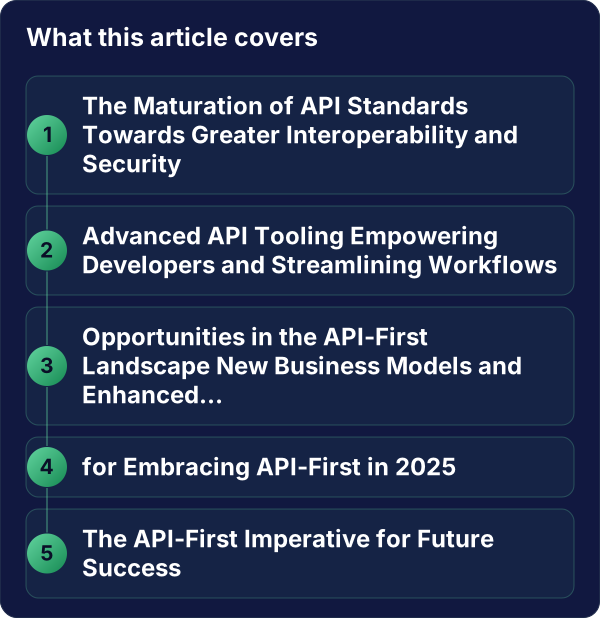
Advanced API Tooling: Empowering Developers and Streamlining Workflows
The proliferation of API-first strategies is directly fueling innovation in API tooling. The focus in 2025 will be on tools that enhance developer experience (DX), automate complex tasks, and provide deeper insights into API performance and security.
Developer Portals: The Central Hub for API Consumption
Modern developer portals are evolving from static documentation sites to dynamic, interactive platforms that are crucial for driving API adoption.
- Interactive Documentation and Sandbox Environments: Expect portals to offer more sophisticated interactive documentation, allowing developers to test API endpoints directly within the portal. Integrated sandbox environments will further reduce the friction of initial integration.
- API Discovery and Cataloging: As organizations build more internal and external APIs, robust cataloging and discovery features become essential. Developer portals will act as a central hub for finding, understanding, and accessing available APIs.
- Community and Support Features: Integrated forums, Q&A sections, and feedback mechanisms will foster a stronger developer community around your APIs, leading to faster issue resolution and improved API design based on user input. Key metrics here include API adoption rate and developer satisfaction scores.
API Management Platforms: Beyond Basic Gateway Functions
API Management Platforms (AMPs) are becoming more sophisticated, offering a comprehensive suite of tools for the entire API lifecycle, from design and development to deployment, security, and analytics.
- Enhanced Security and Governance: AMPs will offer more advanced security features, including fine-grained access control, threat detection, and automated compliance checks. This is critical for B2B software where data security and regulatory compliance are non-negotiable.
- Intelligent Analytics and Monitoring: Beyond basic traffic monitoring, AMPs will provide deeper insights into API usage patterns, performance bottlenecks, and potential revenue opportunities. This data is invaluable for product leaders to make informed decisions.
- Low-Code/No-Code API Integration: The trend towards democratizing API integration will continue, with AMPs offering more low-code/no-code solutions for connecting different services, enabling business users to leverage API capabilities without deep technical expertise.
AI and Machine Learning in API Operations
Artificial intelligence and machine learning are poised to revolutionize API management and development.
- Intelligent API Design Assistance: AI tools can analyze existing code and usage patterns to suggest API designs, identify potential issues, and optimize API performance.
- Automated Security Threat Detection: ML algorithms can learn normal API behavior and flag anomalous activities, providing a proactive defense against security breaches.
- Predictive Performance Monitoring: AI can predict potential performance issues before they impact users, allowing for proactive maintenance and resource allocation. This can lead to a significant reduction in downtime.
- Smart Documentation Generation: AI can assist in generating and updating API documentation, ensuring it remains accurate and comprehensive.
Opportunities in the API-First Landscape: New Business Models and Enhanced Value
The widespread adoption of API-first strategies is unlocking new avenues for business growth and creating enhanced value for both providers and consumers of software.
The Rise of Composable Businesses and Microservices
The API-first approach is the bedrock of the composable enterprise. By breaking down monolithic applications into smaller, independent, and API-discoverable services, businesses can achieve greater agility and flexibility.
- Rapid Innovation Cycles: New features and functionalities can be developed and deployed independently, accelerating innovation and allowing businesses to respond quickly to market changes.
- Best-of-Breed Technology Adoption: Organizations can easily integrate specialized third-party services through APIs, adopting the best available solutions for specific needs without being locked into a single vendor.
- Increased Resilience: If one microservice fails, it doesn’t necessarily bring down the entire application, leading to more robust and fault-tolerant systems.
API as a Product: Monetization and Ecosystem Building
Treating APIs as products in their own right opens up significant monetization opportunities and fosters vibrant ecosystems.
- Direct Revenue Streams: Companies can directly monetize access to their APIs, offering tiered subscription plans based on usage, features, or support levels. This is a key strategy for increasing Average Revenue Per User (ARPU).
- Indirect Value Creation: Even if not directly monetized, well-designed APIs can drive adoption of core products and services by enabling seamless integrations with partners and third-party developers.
- Building Developer Ecosystems: A strong developer community built around your APIs can lead to innovation, co-creation, and a powerful network effect, driving long-term growth and competitive advantage. Tracking developer engagement metrics and number of active integrations is crucial here.
Enhanced Customer Experience through Seamless Integrations
For B2B software, the ability to integrate seamlessly with other tools in a customer’s tech stack is a major differentiator. An API-first approach makes this possible.
- Streamlined Workflows: Customers can connect your software to their existing CRM, ERP, marketing automation, or project management tools, creating unified workflows and eliminating data silos. This directly impacts customer retention rates and Net Promoter Score (NPS).
- Personalized Solutions: By exposing APIs, you empower customers to build custom solutions tailored to their unique business processes, increasing the perceived value of your offering.
- Reduced Implementation Time and Costs: Pre-built integrations and well-documented APIs significantly reduce the time and effort required for customers to onboard and start using your software effectively.
Checklist for Embracing API-First in 2025
To successfully navigate the API-first landscape in 2025, product leaders, CTOs, and technology teams should consider the following steps:
- Define Your API Strategy: Clearly articulate your API vision, identifying which APIs will be internal, external, or partner-facing, and what business objectives they will serve.
- Prioritize Developer Experience (DX): Invest in high-quality documentation, SDKs, and sandbox environments. A positive DX is paramount for API adoption.
- Adopt a Design-First Approach: Use tools like OpenAPI to design your APIs before writing code, ensuring alignment with business needs and facilitating collaboration.
- Implement Robust API Management: Select an API management platform that supports your security, governance, and analytics requirements.
- Embrace Standards: Adhere to industry standards like OpenAPI and AsyncAPI to ensure interoperability and leverage existing tooling.
- Invest in Security: Make API security a top priority, implementing authentication, authorization, rate limiting, and threat detection mechanisms.
- Monitor and Analyze API Performance: Continuously track API usage, performance, and errors to identify areas for improvement and potential revenue opportunities.
- Foster a Developer Community: Engage with your API consumers, provide support, and gather feedback to drive continuous improvement.
- Explore AI/ML Opportunities: Investigate how AI and ML can enhance your API design, security, and operational efficiency.
- Plan for Scalability: Design your APIs and underlying infrastructure to handle increasing loads and evolving business demands.
Conclusion: The API-First Imperative for Future Success
The API-first trends 2025 clearly indicate a future where interconnectedness, developer empowerment, and intelligent automation are non-negotiable. For B2B software agencies and startups, adopting an API-first strategy is not merely about building APIs; it’s about fundamentally rethinking how software is designed, delivered, and consumed. By embracing robust standards, leveraging advanced tooling, and capitalizing on the opportunities presented by a composable and API-driven world, businesses can unlock new revenue streams, enhance customer experiences, and build a sustainable competitive advantage.
Building or migrating toward an API-first strategy? Alken designs and implements API integrations with well-defined contracts, observability and security from day one.
Reach out at info@alken.dev to discuss your case.