How to evaluate a new digital product’s viability in 2 weeks
Master the digital product viability analysis in just 2 weeks. Learn actionable steps for product leaders and CTOs to de-risk innovation.
In the fast-paced world of digital innovation, launching a product that misses the mark can be a costly and demoralizing experience. For product leaders, CTOs, and technology teams in agencies and startups, the pressure to identify winning ideas early is immense. But how can you confidently assess the potential of a new digital product without sinking months into development? The answer lies in a focused, rapid digital product viability analysis.
This isn’t about guesswork or gut feelings. It’s about employing a structured, data-driven approach to de-risk your innovation pipeline and ensure you’re investing resources in concepts with genuine market potential. We’ll guide you through a condensed, two-week framework designed to deliver actionable insights, helping you make informed decisions and accelerate your path to market.
Week 1: Laying the Foundation – Problem & Solution Validation
The first week is dedicated to deeply understanding the problem you aim to solve and validating that your proposed solution resonates with your target audience. This phase is crucial for a robust análisis viabilidad producto digital (digital product viability analysis).
H2: Deep Dive into the Problem Space
Before you even think about features, you need to be absolutely certain that a significant problem exists and that people are actively seeking a solution.
H3: Identifying and Quantifying the Pain Point
- Customer Interviews: Conduct 10-15 in-depth interviews with your target customer segment. Focus on open-ended questions that uncover their daily challenges, existing workarounds, and unmet needs.
- Example: Instead of “Do you need a better way to manage invoices?”, ask “Walk me through your current process for handling client invoices. What are the most frustrating aspects of this process?”
- Market Research & Trend Analysis: Analyze industry reports, competitor offerings, and emerging trends. Look for data that quantifies the size of the problem and its impact.
- KPI Focus: Market size, growth rate of the problem area, customer acquisition cost (CAC) for existing solutions.
- Surveys: Supplement interviews with targeted surveys to gather quantitative data on the prevalence and severity of the identified problem across a larger sample.
- Metric: Net Promoter Score (NPS) for current solutions, willingness to pay for a better solution.
H3: Defining the Ideal Customer Profile (ICP)
A clear understanding of your ICP is paramount. Who experiences this problem most acutely? What are their demographics, psychographics, and professional roles?
- Persona Development: Create 2-3 detailed customer personas representing your ICP. This helps humanize your target audience and ensures all subsequent decisions are customer-centric.
- Segmentation: Identify specific sub-segments within your ICP that might have unique needs or higher propensity to adopt your solution.
H2: Validating Your Proposed Solution
Once you’ve confirmed the problem and identified your audience, it’s time to test your core solution hypothesis.
H3: Crafting a Compelling Value Proposition
Your value proposition must clearly articulate the unique benefits your product offers and how it solves the identified problem better than existing alternatives.
- Lean Canvas or Business Model Canvas: Use these frameworks to articulate your core assumptions about the problem, solution, key metrics, unique value proposition, and channels.
- A/B Testing Messaging: Test different versions of your value proposition on landing pages or in ad campaigns to see which resonates most with your target audience.
- KPI Focus: Click-through rates (CTR) on value proposition-driven ads, conversion rates on landing pages.
H3: Prototyping and Early Feedback
You don’t need a fully built product to get feedback. Low-fidelity prototypes are powerful tools for validation.
- Wireframes & Mockups: Create visual representations of your core user flows and key features.
- Interactive Prototypes: Use tools like Figma, InVision, or Adobe XD to create clickable prototypes that simulate the user experience.
- Usability Testing: Conduct moderated or unmoderated usability tests with your ICP. Observe how they interact with the prototype and gather feedback on clarity, ease of use, and perceived value.
- Metric: Task completion rate, perceived usefulness score, qualitative feedback on pain points and delights.
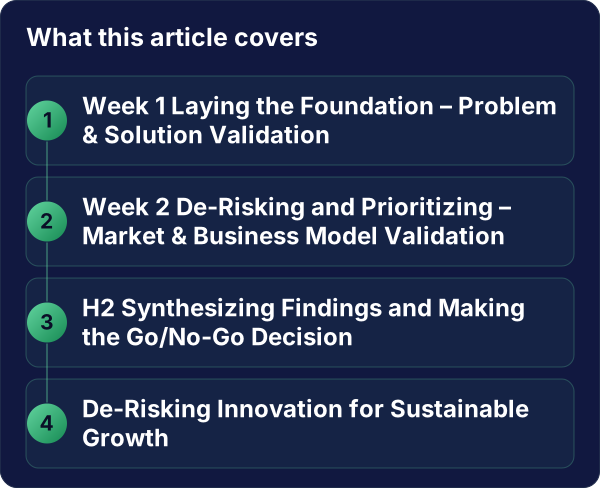
Week 2: De-Risking and Prioritizing – Market & Business Model Validation
The second week shifts focus to the market landscape, your business model, and how to prioritize potential features. This is where the análisis viabilidad producto digital really solidifies.
H2: Assessing Market Opportunity and Competition
Understanding the competitive landscape and the broader market is critical for determining your product’s potential for success.
H3: Competitive Analysis
Identify direct and indirect competitors. Analyze their strengths, weaknesses, pricing, market share, and customer reviews.
- SWOT Analysis: Conduct a SWOT (Strengths, Weaknesses, Opportunities, Threats) analysis for your product relative to the competition.
- Feature Comparison Matrix: Create a matrix comparing your proposed features against those of key competitors. Identify gaps and areas where you can differentiate.
- KPI Focus: Market share of competitors, pricing benchmarks, customer satisfaction scores of competing products.
H3: Market Sizing and Potential
Quantify the addressable market for your solution.
- TAM, SAM, SOM: Estimate your Total Addressable Market (TAM), Serviceable Available Market (SAM), and Serviceable Obtainable Market (SOM).
- Growth Projections: Research market growth trends to understand the long-term potential.
- Metric: Projected annual recurring revenue (ARR) based on SOM and pricing.
H2: Validating the Business Model and Monetization Strategy
A great product is only viable if it can sustain itself financially.
H3: Monetization Strategy Testing
Explore and test different pricing models and revenue streams.
- Pricing Experiments: If possible, test different price points on landing pages or through surveys. Understand customer price sensitivity.
- Value-Based Pricing: Align your pricing with the perceived value your product delivers to the customer.
- Metric: Willingness to pay, average revenue per user (ARPU).
H3: Financial Projections and Unit Economics
Develop initial financial projections and understand your unit economics.
- Cost of Goods Sold (COGS) / Cost of Service: Estimate the direct costs associated with delivering your product.
- Customer Lifetime Value (CLTV) vs. Customer Acquisition Cost (CAC): Aim for a CLTV:CAC ratio of at least 3:1.
- KPI Focus: Projected profitability, break-even point, CLTV:CAC ratio.
H2: Prioritizing Features with the ICE/RICE Framework
Not all features are created equal. Prioritization is key to focusing development efforts on what will deliver the most value. The ICE (Impact, Confidence, Ease) or RICE (Reach, Impact, Confidence, Effort) frameworks are excellent tools for this.
H3: Understanding ICE/RICE
- ICE Score: Impact (how much will this feature move the needle?), Confidence (how sure are we about the impact?), Ease (how easy is it to implement?). Score each on a scale of 1-10. ICE Score = Impact x Confidence x Ease.
- RICE Score: Reach (how many users will this feature affect?), Impact (how much will this feature affect users?), Confidence (how confident are we in our estimates?), Effort (how much time will this take to build?). Score Reach and Impact (e.g., on a scale of 1-10 or by user count), Confidence (as a percentage), and Effort (in person-months). RICE Score = (Reach x Impact x Confidence) / Effort.
H3: Applying the Framework
- Brainstorm Features: List all potential features for your minimum viable product (MVP).
- Assign Scores: For each feature, assign scores for each component of ICE or RICE. This often requires team consensus.
- Calculate Scores: Compute the ICE or RICE score for each feature.
- Prioritize: Rank features by their scores. Higher scores indicate higher priority.
- Example:
- Feature A: User Onboarding Tutorial
- ICE: Impact (8), Confidence (9), Ease (7) = 504
- RICE: Reach (1000 users/month), Impact (2), Confidence (90%), Effort (1 person-month) = (1000 * 2 * 0.9) / 1 = 1800
- Feature B: Advanced Reporting Dashboard
- ICE: Impact (9), Confidence (6), Ease (3) = 162
- RICE: Reach (200 users/month), Impact (3), Confidence (70%), Effort (3 person-months) = (200 * 3 * 0.7) / 3 = 140
- Feature A: User Onboarding Tutorial
In this example, the Onboarding Tutorial (Feature A) would be prioritized over the Advanced Reporting Dashboard (Feature B) based on these scores.
H2: Synthesizing Findings and Making the Go/No-Go Decision
The culmination of your two-week effort is synthesizing all the data and making a clear decision.
H3: Creating a Viability Report
Compile all your findings into a concise report. This should include:
- Executive Summary of findings.
- Validated problem statement and ICP.
- Key customer feedback and insights.
- Competitive landscape overview.
- Market opportunity assessment.
- Proposed solution and value proposition.
- Business model and monetization strategy.
- Prioritized feature list (MVP scope).
- Risk assessment and mitigation strategies.
- Financial projections and key metrics.
H3: The Go/No-Go Decision
Based on the report, your team should be able to make an informed decision:
- Go: Proceed with development, with a clear roadmap and MVP scope.
- Pivot: The core problem is valid, but the proposed solution needs adjustment. Revisit solution validation with new hypotheses.
- No-Go: The problem isn’t significant enough, the market is too crowded, or the business model is unviable. Save resources and explore other opportunities.
Conclusion: De-Risking Innovation for Sustainable Growth
A rigorous análisis viabilidad producto digital is not a luxury; it’s a necessity for any agency or startup aiming for sustainable growth in the digital product space. By dedicating just two weeks to this focused process, you can significantly de-risk your innovation efforts, ensuring you invest in products that truly solve customer problems and have a clear path to market success.
This structured approach allows you to gather critical data, validate assumptions, and make confident, data-driven decisions, transforming potential risks into strategic advantages.
Evaluating the viability of your next digital product? Alken works on custom software from the discovery phase — validating assumptions before investing in development.
Reach out at info@alken.dev to discuss your case.