How to migrate a SPA monolith to micro frontends without chaos
Master your SPA monolith to micro frontends migration with our expert guide. Avoid chaos, ensure success. Learn strategies, phases, and risks.

The monolithic Single Page Application (SPA) has long been the workhorse for many ambitious startups and established agencies. It offers simplicity in development and deployment for early-stage products. However, as your application grows in complexity, user base, and team size, the monolith can become a significant bottleneck. This is where the allure of micro frontends shines. Embracing a micro frontends migration strategy can unlock scalability, team autonomy, and faster development cycles. But the path from a unified monolith to a distributed micro frontend architecture is fraught with potential pitfalls. This guide will equip product leaders, CTOs, and technology teams with the knowledge to navigate this complex transition successfully, minimizing chaos and maximizing value.
The Monolith’s Growing Pains: Why Consider a Micro Frontends Migration?
As your SPA matures, you’ll likely encounter several indicators that a monolithic architecture is no longer serving your needs effectively:
- Decreased Development Velocity: Large codebases become harder to understand, modify, and test. Developers spend more time navigating dependencies and less time building new features. This can lead to a noticeable drop in your feature release velocity, a key KPI for product teams.
- Team Bottlenecks and Dependencies: As your engineering team grows, coordinating work on a single, massive codebase becomes increasingly challenging. Cross-team dependencies slow down progress, and merge conflicts become a daily occurrence. This directly impacts your cycle time and lead time for changes.
- Technology Stack Stagnation: A monolith often locks you into a specific technology stack. Introducing new frameworks or libraries can be a monumental task, hindering innovation and the adoption of more efficient tools.
- Scalability Challenges: Scaling a monolithic application often means scaling the entire application, even if only a small part is experiencing high load. This is inefficient and costly.
- Onboarding Difficulties: New developers face a steep learning curve when trying to grasp the intricacies of a large, complex monolith, increasing time-to-productivity.
A micro frontends migration offers a compelling solution by breaking down the UI into smaller, independent, and deployable units. Each micro frontend can be developed, deployed, and scaled independently, fostering team autonomy and accelerating innovation.
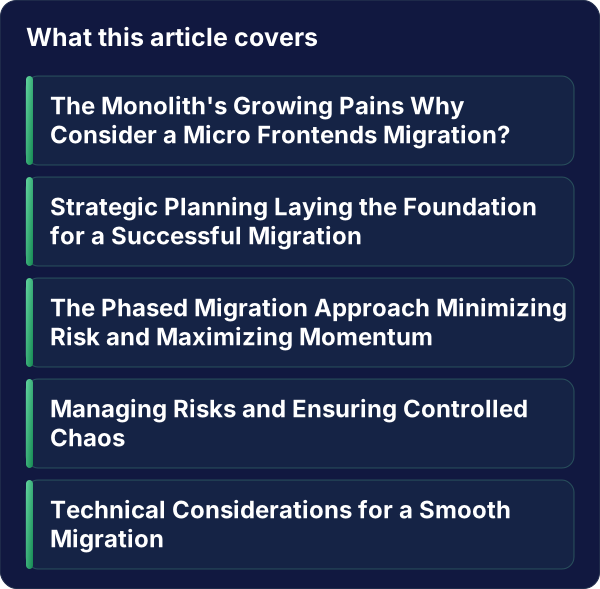
Strategic Planning: Laying the Foundation for a Successful Migration
A successful micro frontends migration is not a purely technical endeavor; it requires meticulous strategic planning. Rushing into implementation without a clear roadmap is a recipe for disaster.
Defining Your “Why” and “What”
Before diving into technical details, clearly articulate the business objectives driving this migration. What specific problems are you trying to solve? What KPIs do you aim to improve?
- Business Goals: Increased agility, faster time-to-market for specific features, improved user experience in certain modules, enabling independent team growth.
- Technical Goals: Technology stack diversification, improved code maintainability, enhanced scalability, reduced build times.
Identifying Candidate Micro Frontends
Not every part of your monolith needs to become a micro frontend immediately. A phased approach is crucial. Identify distinct, self-contained features or modules that can logically be separated.
- Business Domain Alignment: Look for areas of your application that map to clear business domains (e.g., user profile, product catalog, checkout).
- Team Autonomy: Consider modules that are currently, or could be, owned by a single, dedicated team.
- Independent Deployability: Can this module be deployed without impacting other parts of the application?
- Complexity Threshold: Modules that are becoming overly complex and difficult to manage within the monolith are prime candidates.
Choosing Your Integration Strategy
How will these independent micro frontends come together to form a cohesive user experience? Several integration strategies exist, each with its own trade-offs:
- Build-Time Integration: Micro frontends are published as libraries and consumed by a container application. Simple, but sacrifices independent deployment.
- Run-Time Integration (Client-Side):
- JavaScript Composition: A container application orchestrates the loading and mounting of micro frontends using JavaScript. This is a popular approach, often leveraging module federation (e.g., Webpack 5’s Module Federation).
- iFrames: Each micro frontend runs in its own isolated iFrame. Offers strong isolation but can lead to UX challenges and communication complexities.
- Web Components: Micro frontends are built as reusable Web Components, allowing them to be composed within any framework.
- Run-Time Integration (Server-Side): Server-side includes (SSI) or Edge Side Includes (ESI) can assemble pages from different micro frontend services before sending them to the browser. This can improve initial load performance.
The choice of integration strategy will heavily influence your deployment complexity and runtime performance.
The Phased Migration Approach: Minimizing Risk and Maximizing Momentum
A “big bang” micro frontends migration is rarely advisable. A phased approach allows you to learn, adapt, and build confidence with each step.
Phase 1: Preparation and Foundation
This phase is about setting the stage and establishing the core infrastructure.
- Establish Core Infrastructure:
- Shared Libraries/Design System: Define and implement a shared library for common UI components, styling, and utility functions. This is crucial for maintaining visual consistency and reducing code duplication across micro frontends.
- Communication Layer: Design a robust mechanism for micro frontends to communicate with each other (e.g., custom events, a shared event bus, or a dedicated state management solution).
- Routing Strategy: Decide how navigation will be handled. Will there be a single router in the container, or will each micro frontend manage its own routes?
- Build and Deployment Pipeline: Set up CI/CD pipelines that support independent builds and deployments for each micro frontend.
- Pilot Project Selection: Choose a small, relatively isolated, and low-risk feature or module as your first micro frontend. This allows your team to experiment and iron out initial challenges.
- Team Training and Alignment: Ensure your development teams understand the micro frontend philosophy, the chosen integration strategy, and the new tooling.
Phase 2: Incremental Extraction and Development
This is where the actual migration begins, module by module.
- Extract the First Micro Frontend:
- Code Isolation: Carefully extract the chosen module’s code from the monolith. This might involve refactoring shared dependencies.
- Build as a Standalone Application: Configure it to be built and deployed independently.
- Integrate with the Container: Implement the chosen integration strategy to connect it with the existing monolith or a new container application.
- Iterate and Refine: Deploy the first micro frontend to production. Monitor its performance, stability, and developer experience. Gather feedback and make necessary adjustments to your infrastructure and processes.
- Extract Subsequent Micro Frontends: Repeat the extraction and integration process for other identified modules. Prioritize based on business value, complexity, and team readiness.
Phase 3: Decommissioning the Monolith
As more functionality is migrated to micro frontends, the monolith will shrink.
- Gradual Removal of Code: Once a module is fully migrated and stable, remove its corresponding code from the monolith.
- Final Decommissioning: Eventually, the monolith will be reduced to a minimal core or entirely retired.
Managing Risks and Ensuring Controlled Chaos
While micro frontends offer significant advantages, they also introduce new complexities. Proactive risk management is essential.
Key Risks and Mitigation Strategies
- Increased Complexity:
- Risk: Managing multiple repositories, build pipelines, and deployment strategies can become overwhelming.
- Mitigation: Invest in robust CI/CD automation. Standardize tooling and processes as much as possible. Implement clear documentation and knowledge sharing practices.
- Performance Overhead:
- Risk: Loading multiple JavaScript bundles, inter-frontend communication, and duplicated dependencies can impact performance.
- Mitigation: Employ strategies like code splitting, lazy loading, and efficient caching. Leverage module federation for shared dependencies. Optimize communication patterns. Monitor page load times and time to interactive (TTI) closely.
- Inconsistent User Experience:
- Risk: Different teams working on separate micro frontends can lead to design inconsistencies and a fragmented user experience.
- Mitigation: Implement a strong, shared design system. Establish clear guidelines for UI development. Conduct regular UX reviews.
- Operational Overhead:
- Risk: Monitoring, logging, and debugging across multiple independent services can be more challenging.
- Mitigation: Implement centralized logging and monitoring solutions. Use distributed tracing to track requests across micro frontends. Define clear SLOs (Service Level Objectives) for each micro frontend.
- Team Coordination and Communication:
- Risk: While aiming for autonomy, teams still need to coordinate effectively.
- Mitigation: Foster a culture of open communication. Establish clear ownership boundaries. Implement regular cross-team sync-ups for architectural discussions.
- Security Vulnerabilities:
- Risk: A larger attack surface with multiple independent deployments can introduce new security risks.
- Mitigation: Implement consistent security practices across all micro frontends. Conduct regular security audits. Ensure secure communication channels between micro frontends.
Technical Considerations for a Smooth Migration
The technical implementation of a micro frontends migration requires careful consideration of several key areas.
Choosing the Right Technology Stack for Micro Frontends
While the goal is often to allow teams to choose their preferred stacks, you’ll need a strategy for the “container” or orchestrating application.
- Container Application: This could be a lightweight framework or even a simple HTML shell that loads the micro frontends.
- Micro Frontend Frameworks/Libraries: Consider frameworks that facilitate micro frontend development, such as:
- Single-SPA: A framework for composing micro frontends.
- Module Federation (Webpack 5): Enables dynamic code sharing between independently deployable applications.
- Luigi: An open-source micro frontend framework from SAP.
- Web Components: As mentioned, they offer framework-agnostic encapsulation.
State Management and Communication
How will your micro frontends share data and communicate?
- Custom Events: A lightweight way for micro frontends to signal events to each other.
- Shared Event Bus: A centralized mechanism for broadcasting and subscribing to events.
- Browser Storage: Using
localStorageorsessionStoragefor simple shared data. - Dedicated State Management Library: For complex scenarios, a shared instance of a state management library (e.g., Redux, Zustand) can be used, though this introduces a shared dependency.
- Backend for Frontend (BFF): Each micro frontend might have its own BFF to handle backend communication, reducing direct client-to-API calls and simplifying data aggregation.
Routing and Navigation
- Centralized Routing: A single router in the container application manages all routes.
- Decentralized Routing: Each micro frontend manages its own routes, with the container application providing a base path.
- Hybrid Approaches: Combining aspects of both.
Authentication and Authorization
- Single Sign-On (SSO): Essential for a seamless user experience.
- Token-Based Authentication: Passing authentication tokens between micro frontends.
- Centralized Auth Service: A dedicated service managing authentication and authorization.
Checklist for a Successful Micro Frontends Migration
To help you stay organized and on track, here’s a comprehensive checklist:
- Clearly define business and technical objectives for the migration.
- Identify and prioritize candidate modules for extraction.
- Select an appropriate integration strategy (e.g., Module Federation, Single-SPA).
- Establish a shared design system and component library.
- Design and implement a robust communication layer.
- Set up standardized CI/CD pipelines for independent deployments.
- Choose and train teams on the selected micro frontend technologies.
- Select a pilot project for the initial extraction.
- Develop a phased migration plan with clear milestones.
- Implement robust monitoring, logging, and alerting for all micro frontends.
- Define clear ownership and responsibilities for each micro frontend.
- Establish a strategy for handling shared dependencies.
- Plan for authentication and authorization across micro frontends.
- Conduct regular code reviews and architectural discussions.
- Continuously measure and iterate based on performance metrics and team feedback.
- Plan for the eventual decommissioning of the monolith.
Conclusion: Embracing Agility Through Micro Frontends
Migrating from a SPA monolith to micro frontends is a significant undertaking, but one that can unlock unparalleled agility, scalability, and developer productivity. By adopting a strategic, phased approach, meticulously planning your integration and communication strategies, and proactively managing risks, you can navigate this transition without succumbing to chaos. The benefits – faster feature delivery, empowered teams, and a more resilient architecture – are well worth the effort.
Evaluating or executing a micro frontends migration? Alken builds web applications with modern architectures — from monolithic SPAs to micro frontends — with incremental delivery and no downtime.
Reach out at info@alken.dev to discuss your case.