KPIs for product teams: what to measure without losing focus
Master product team KPIs. Discover essential metrics for focus and success. Drive outcomes with data-driven insights.

In the fast-paced world of software development, especially for B2B agencies and startups, the ability to measure progress and impact is paramount. Product leaders, CTOs, and technology teams are constantly seeking ways to optimize their efforts, ensure their products deliver value, and maintain a clear line of sight to their strategic goals. This is where understanding and implementing the right product team KPIs becomes not just beneficial, but essential.
However, the sheer volume of potential metrics can be overwhelming. It’s easy to get lost in a sea of data, tracking vanity metrics that don’t truly reflect business success or product health. The key is to identify kpis equipo producto – those crucial indicators that truly matter for your product’s growth and your team’s effectiveness. This article will guide you through what to measure, why it matters, and how to use these metrics to drive focus and achieve tangible outcomes.
The Foundation: Understanding Outcome vs. Output Metrics
Before diving into specific kpis equipo producto, it’s crucial to distinguish between two fundamental types of metrics: outcome metrics and output metrics. Misunderstanding this distinction is a common pitfall that leads to measuring the wrong things.
Outcome Metrics: The “Why”
Outcome metrics measure the impact of your product and your team’s work on the business and its users. They answer the question: “What value are we creating?” These are the most important kpis equipo producto because they directly tie your team’s efforts to business objectives.
- Examples:
- Customer Lifetime Value (CLTV)
- Net Promoter Score (NPS)
- Customer Acquisition Cost (CAC)
- Churn Rate
- Revenue Growth
- User Engagement (e.g., Daily Active Users - DAU, Monthly Active Users - MAU)
- Feature Adoption Rate
Output Metrics: The “How”
Output metrics measure the effort or activity of the team. They answer the question: “What are we doing?” While useful for understanding team velocity and process efficiency, they don’t inherently tell you if that activity is leading to desired outcomes.
- Examples:
- Number of features shipped
- Lines of code written
- Bugs fixed
- Story points completed
- Sprint velocity
The Critical Insight: Focusing solely on output metrics can lead to a team that is busy but not effective. They might ship many features, but if those features don’t solve user problems or drive business goals, the effort is wasted. The best kpis equipo producto are those that reflect positive shifts in outcome metrics.
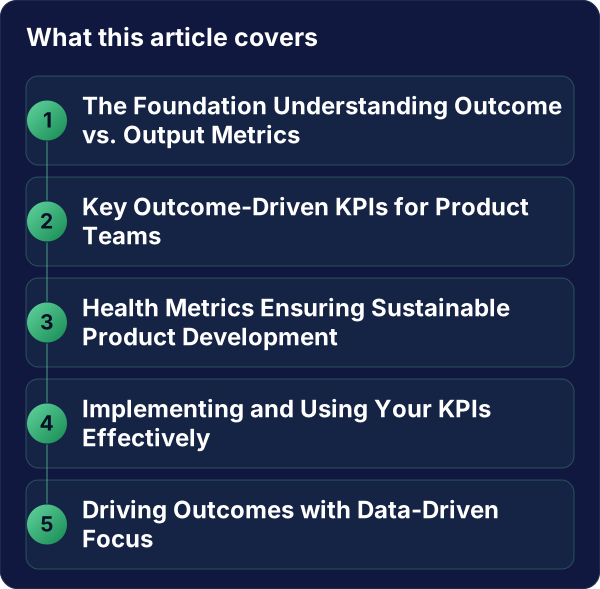
Key Outcome-Driven KPIs for Product Teams
To build a successful product, you need to track metrics that demonstrate real value. These kpis equipo producto are designed to keep your team aligned with strategic objectives and user needs.
1. Customer Satisfaction & Loyalty KPIs
Understanding how your customers feel about your product is fundamental. Happy customers are more likely to stay, refer others, and spend more.
- Net Promoter Score (NPS): This classic metric measures customer loyalty by asking how likely users are to recommend your product on a scale of 0-10.
- Calculation: % Promoters (score 9-10) - % Detractors (score 0-6).
- Why it matters: A rising NPS indicates increasing customer satisfaction and a strong potential for organic growth.
- Customer Satisfaction Score (CSAT): Typically measured after a specific interaction (e.g., using a new feature, contacting support), CSAT asks users to rate their satisfaction.
- Calculation: (Number of satisfied customers / Total number of responses) * 100.
- Why it matters: Provides granular feedback on specific product experiences.
- Customer Effort Score (CES): Measures how much effort a customer had to exert to get an issue resolved, a request fulfilled, or a purchase made.
- Calculation: Average score on a Likert scale (e.g., “How easy was it to…”).
- Why it matters: High effort often leads to frustration and churn. Reducing effort is a powerful driver of loyalty.
2. Business & Revenue KPIs
Ultimately, your product needs to contribute to the financial health of your business. These kpis equipo producto directly link product performance to revenue and profitability.
- Customer Lifetime Value (CLTV): The total revenue a customer is expected to generate throughout their relationship with your company.
- Calculation: (Average Purchase Value * Average Purchase Frequency) * Average Customer Lifespan.
- Why it matters: A high CLTV indicates that your product is providing sustained value and fostering long-term customer relationships.
- Customer Acquisition Cost (CAC): The total cost of sales and marketing efforts required to acquire a new customer.
- Calculation: Total Sales & Marketing Expenses / Number of New Customers Acquired.
- Why it matters: You need to ensure your CLTV is significantly higher than your CAC for sustainable growth.
- Churn Rate: The percentage of customers who stop using your product or service over a given period.
- Calculation: (Number of Customers Lost / Total Customers at Start of Period) * 100.
- Why it matters: High churn is a major red flag. It indicates issues with product value, user experience, or market fit. Reducing churn is often more cost-effective than acquiring new customers.
- Monthly Recurring Revenue (MRR) / Annual Recurring Revenue (ARR): For subscription-based businesses, these are critical metrics for predictable revenue.
- Why it matters: Tracks the health and growth of your subscription base.
3. Product Usage & Engagement KPIs
These kpis equipo producto help you understand how users interact with your product, which features they use, and how often.
- Daily Active Users (DAU) / Monthly Active Users (MAU): Measures the number of unique users who engage with your product on a daily or monthly basis.
- Why it matters: Indicates the overall stickiness and adoption of your product.
- DAU/MAU Ratio (Stickiness Ratio): A higher ratio suggests users are returning more frequently.
- Why it matters: A strong indicator of habit formation and deep engagement.
- Feature Adoption Rate: The percentage of users who use a specific feature.
- Calculation: (Number of users who used Feature X / Total Number of Active Users) * 100.
- Why it matters: Helps you understand which features are resonating with users and which might need improvement or better promotion.
- Session Duration & Frequency: How long users spend in the product and how often they visit.
- Why it matters: Can indicate depth of engagement, but context is key. Long sessions for complex tasks might be good, while long sessions for simple tasks could signal inefficiency.
Health Metrics: Ensuring Sustainable Product Development
Beyond direct business outcomes, it’s vital to monitor the internal health of your product and development process. These kpis equipo producto ensure you’re building sustainably and efficiently.
1. Development Velocity & Efficiency
While not outcome metrics, these can inform process improvements that lead to better outcomes.
- Lead Time: The time it takes from when a request or idea is conceived to when it’s delivered to the customer.
- Why it matters: Shorter lead times mean faster iteration and quicker delivery of value.
- Cycle Time: The time it takes from when work begins on an item (e.g., a story) to when it’s completed.
- Why it matters: Helps identify bottlenecks in the development process.
- Deployment Frequency: How often your team successfully deploys code to production.
- Why it matters: Higher frequency often correlates with smaller, less risky releases and faster feedback loops.
2. Product Quality & Stability
A product that is buggy or unstable will quickly erode user trust and satisfaction, directly impacting outcome metrics.
- Bug Count & Severity: Tracking the number of bugs reported and their severity.
- Why it matters: A high number of critical bugs will cripple user experience and business operations.
- Mean Time To Recovery (MTTR): The average time it takes to restore service after an outage or failure.
- Why it matters: Crucial for minimizing downtime and its impact on users and revenue.
- Uptime: The percentage of time the product is available and functioning as expected.
- Why it matters: Essential for reliability and customer trust.
Implementing and Using Your KPIs Effectively
Simply tracking kpis equipo producto isn’t enough. You need a strategy for their implementation and ongoing use.
Checklist: Setting Up Your Product Team KPIs
- Define Your Product Strategy & Goals: What are you trying to achieve? What are your North Star metrics?
- Align KPIs with Goals: Ensure every KPI directly or indirectly supports a strategic objective.
- Prioritize Ruthlessly: Don’t track everything. Focus on the 3-5 most impactful kpis equipo producto for your current stage.
- Establish Baselines: Measure your current performance before implementing changes.
- Set Clear Targets: Define what success looks like for each KPI.
- Automate Tracking: Use analytics tools, dashboards, and reporting to gather data efficiently.
- Regularly Review & Discuss: Make KPI review a standard part of your team meetings.
- Act on Insights: The most important step. Use the data to make informed decisions, iterate, and improve.
- Re-evaluate Periodically: As your product and business evolve, so should your KPIs.
The Danger of Vanity Metrics
Vanity metrics are numbers that look good on paper but don’t actually contribute to your business goals. Examples include:
- Total number of downloads (without considering active usage)
- Number of social media followers (without engagement)
- Raw page views (without conversion or engagement context)
Always ask yourself: “Does this metric help me make a better decision or understand if we’re moving closer to our goals?” If the answer is no, it’s likely a vanity metric.
Conclusion: Driving Outcomes with Data-Driven Focus
Mastering kpis equipo producto is about more than just collecting data; it’s about cultivating a data-informed culture. By focusing on outcome metrics that truly reflect customer value and business impact, while also monitoring product and development health, you can ensure your product team is not just busy, but effective. This strategic approach to measurement allows you to maintain focus, identify opportunities for growth, and build products that truly resonate with your target audience.
At Alken, we understand the challenges B2B agencies and startups face in navigating the complex landscape of product development and measurement. We help teams identify, implement, and leverage the right kpis equipo producto to drive tangible business outcomes.
Ready to transform your product strategy with data-driven insights?
Contact us today at info@alken.dev to learn how Alken can help your team achieve its goals.