How to design an internal operations platform without overengineering
Build an efficient internal operations platform for your agency or startup without the complexity. Learn how to avoid overengineering and drive growth.
In the fast-paced world of agencies and startups, efficiency isn’t just a buzzword; it’s the engine of growth. As your business scales, the complexity of managing day-to-day operations can quickly outpace your existing tools and processes. This is where a well-designed internal operations platform becomes indispensable. However, the temptation to build a feature-rich, all-encompassing solution can lead to overengineering, resulting in a system that’s slow to develop, difficult to maintain, and ultimately, a drain on resources.
This article will guide product leaders, CTOs, and technology teams on how to approach the design of an internal operations platform – or what we’ll refer to in its natural English translation as an internal operations platform – with a focus on strategic simplicity, scalability, and measurable impact. We’ll explore how to strike the crucial balance between speed of delivery and long-term maintainability, ensuring your platform empowers your team rather than hinders them.
1. Understanding Your Core Operational Needs: The Foundation of Simplicity
Before a single line of code is written or a single feature is conceptualized, the most critical step is to deeply understand your organization’s core operational needs. This isn’t about listing every possible wish-list item; it’s about identifying the critical workflows and pain points that, if optimized, will yield the most significant improvements in productivity, cost reduction, or revenue generation.
Identifying Key Workflows
Start by mapping out your most vital business processes. For an agency, this might include:
- Client Onboarding: From initial proposal to project kickoff.
- Project Management: Task assignment, progress tracking, resource allocation.
- Time Tracking & Billing: Ensuring accurate capture of billable hours and streamlined invoicing.
- Resource Management: Understanding team capacity and skill allocation.
- Sales Pipeline Management: Tracking leads, opportunities, and deal progression.
For a startup, the focus might shift slightly, perhaps emphasizing:
- Customer Support: Ticket management, knowledge base, response times.
- Product Development Lifecycle: Bug tracking, feature requests, release management.
- Sales & Marketing Automation: Lead nurturing, campaign performance tracking.
- Inventory & Fulfillment (if applicable): Stock levels, order processing.
Prioritizing Pain Points and Opportunities
Once workflows are identified, pinpoint the specific bottlenecks and inefficiencies within them. Ask yourselves:
- Where are we losing the most time?
- What tasks are most prone to human error?
- Which processes are currently manual and repetitive?
- Where is data siloed, making informed decision-making difficult?
- What are the key metrics (KPIs) we struggle to track or improve due to operational friction? (e.g., Client Satisfaction Score (CSAT), Average Project Completion Time, Billing Accuracy Rate, Lead Conversion Rate).
By focusing on these concrete problems, you can define the minimum viable product (MVP) for your internal operations platform. This MVP should directly address the highest-impact pain points, providing immediate value and a clear return on investment.
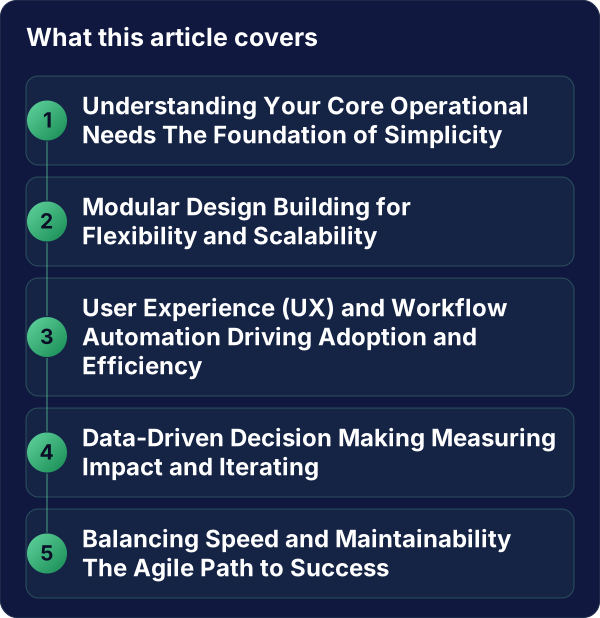
2. Modular Design: Building for Flexibility and Scalability
A common pitfall in building internal tools is creating a monolithic system that’s hard to update or extend. Instead, adopt a modular design philosophy. This means breaking down your internal operations platform into distinct, loosely coupled components or microservices, each responsible for a specific function.
The Power of Microservices and APIs
Think of your platform as a collection of building blocks. Each block (e.g., a client management module, a project tracking module, a billing module) can be developed, tested, and deployed independently. This offers several advantages:
- Faster Development Cycles: Teams can work on different modules concurrently.
- Easier Maintenance and Updates: Issues or improvements in one module don’t necessarily affect others.
- Technology Flexibility: Different modules can potentially use the best technology for their specific job.
- Scalability: Individual modules can be scaled up or down based on demand.
Crucially, these modules should communicate via well-defined Application Programming Interfaces (APIs). This API-first approach ensures that your platform can easily integrate with existing third-party tools (CRM, accounting software, communication platforms) and also allows for future expansion and integration with new internal or external systems.
The “Single Source of Truth” Principle
A key benefit of a modular, API-driven platform is its ability to establish a “single source of truth” for critical business data. Instead of data residing in disparate spreadsheets or siloed applications, your internal operations platform can aggregate and standardize this information. For example, client contact details entered in the CRM module should be accessible and consistent across the project management and billing modules. This reduces data redundancy, improves data integrity, and enables more accurate reporting and analytics.
3. User Experience (UX) and Workflow Automation: Driving Adoption and Efficiency
Even the most technically sound platform will fail if it’s not intuitive and easy to use. For an internal operations platform, UX is paramount for driving adoption and maximizing efficiency gains.
Designing for the End-User
Your internal users are your customers. They are likely busy and may not be tech-savvy. Therefore, the platform’s interface should be:
- Intuitive and Clean: Minimize clutter and use familiar design patterns.
- Task-Oriented: Help users complete their specific tasks quickly and with minimal effort.
- Contextual: Provide relevant information and actions based on the user’s current task or role.
- Accessible: Ensure it works well across different devices and browsers.
Gathering user feedback early and often through usability testing and surveys is crucial. This iterative feedback loop helps refine the UX and ensures the platform meets the actual needs of those who will use it daily.
Automating Repetitive Tasks
The true power of an internal operations platform lies in its ability to automate manual, repetitive, and time-consuming tasks. Identify opportunities for automation within your core workflows:
- Automated Notifications: Alerting team members about upcoming deadlines, task assignments, or client updates.
- Data Entry Automation: Integrating with other systems to automatically pull data, reducing manual input.
- Workflow Triggers: Automatically initiating the next step in a process once a previous step is completed (e.g., once a project is marked as “complete,” automatically trigger the billing process).
- Report Generation: Automating the creation of regular reports on key operational metrics.
By automating these tasks, you free up your team’s time to focus on higher-value activities, reduce errors, and ensure consistency in your processes. This directly impacts KPIs like Average Task Completion Time and Reduction in Manual Errors.
4. Data-Driven Decision Making: Measuring Impact and Iterating
An internal operations platform isn’t just about streamlining processes; it’s a powerful engine for generating insights. By collecting and centralizing data, you can move from gut-feel decisions to data-backed strategies.
Key Metrics and KPIs to Track
Your platform should be designed to track and report on key performance indicators (KPIs) that are critical to your business. Examples include:
- Productivity Metrics:
- Average Time per Task/Project Phase: To identify bottlenecks.
- Team Utilization Rate: To optimize resource allocation.
- Output per Employee: To measure overall team efficiency.
- Financial Metrics:
- Billing Accuracy Rate: To minimize revenue leakage.
- On-Time Invoicing Rate: To improve cash flow.
- Project Profitability: To understand which projects are most successful.
- Client-Facing Metrics:
- Client Onboarding Time: To improve client experience.
- Project Delivery Time: To ensure client satisfaction.
- Customer Support Response Time: To gauge service quality.
Building a Feedback Loop for Continuous Improvement
The data generated by your platform should fuel a continuous improvement cycle. Regularly review your KPIs to:
- Identify areas for further optimization: Where are you still seeing inefficiencies?
- Measure the impact of implemented changes: Did the new automation reduce task completion time?
- Inform future development priorities: Which features or modules will provide the next biggest boost in performance?
This data-driven approach ensures that your internal operations platform evolves with your business, remaining a valuable asset rather than a static piece of software.
5. Balancing Speed and Maintainability: The Agile Path to Success
The tension between delivering quickly and building robust, maintainable software is a constant challenge. For an internal operations platform, finding this balance is key to avoiding technical debt and ensuring long-term viability.
Embracing Agile Development Principles
Agile methodologies are well-suited for building internal tools. They emphasize iterative development, flexibility, and continuous feedback.
- Iterative Development: Build and release features in small, manageable increments. This allows for early validation and reduces the risk of building the “wrong” thing.
- Cross-Functional Teams: Empower small, agile teams with the skills to design, develop, test, and deploy features end-to-end.
- Continuous Integration/Continuous Deployment (CI/CD): Automate the build, test, and deployment process to enable frequent, reliable releases. This significantly speeds up the delivery of new features and bug fixes.
Strategic Technology Choices
When choosing technologies, consider the trade-offs between rapid development and long-term maintainability.
- Leverage Existing Frameworks and Libraries: Don’t reinvent the wheel. Use mature, well-supported frameworks (e.g., React, Vue.js for frontend; Node.js, Python/Django, Ruby on Rails for backend) that have strong communities and extensive documentation.
- Prioritize Readability and Documentation: Write clean, well-commented code. Maintain up-to-date documentation for APIs, architecture, and deployment processes.
- Automated Testing: Implement a comprehensive suite of automated tests (unit, integration, end-to-end). This is non-negotiable for maintainability, as it provides a safety net for refactoring and adding new features. High test coverage directly correlates with reduced bug rates and increased confidence in deployments.
- Consider the “Build vs. Buy” for Components: For certain functionalities, it might be more efficient and maintainable to integrate with specialized third-party SaaS solutions rather than building them from scratch. For example, instead of building a complex analytics dashboard, integrate with a dedicated BI tool.
By focusing on these principles, you can deliver value quickly while building a solid foundation that can adapt and grow with your business.
Checklist for Designing Your Internal Operations Platform
To help you navigate this process, here’s a concise checklist:
- Phase 1: Discovery & Strategy
- Clearly define core business workflows.
- Identify and prioritize key operational pain points and inefficiencies.
- Define measurable goals and KPIs for the platform.
- Identify essential integrations with existing tools.
- Define the Minimum Viable Product (MVP) scope.
- Phase 2: Design & Architecture
- Adopt a modular, API-first architecture.
- Design intuitive and user-friendly interfaces.
- Map out automation opportunities for repetitive tasks.
- Plan for data centralization and a “single source of truth.”
- Select appropriate, maintainable technologies and frameworks.
- Phase 3: Development & Implementation
- Implement agile development methodologies.
- Prioritize automated testing (unit, integration, E2E).
- Establish CI/CD pipelines for efficient deployment.
- Develop core modules and APIs iteratively.
- Conduct regular user testing and gather feedback.
- Phase 4: Deployment & Optimization
- Roll out the MVP to a pilot group.
- Monitor key KPIs and system performance.
- Gather post-launch user feedback.
- Plan for ongoing maintenance and iterative improvements.
- Continuously identify new automation and optimization opportunities.
Conclusion: Empowering Growth Through Strategic Operations
Building an effective internal operations platform is a strategic investment that can significantly accelerate your agency or startup’s growth. By focusing on understanding your core needs, adopting a modular and user-centric design, leveraging data for continuous improvement, and balancing speed with maintainability, you can create a system that empowers your team, streamlines processes, and drives measurable business outcomes.
The key is to avoid the trap of overengineering. Start with what’s essential, build for flexibility, and let your evolving business needs guide your platform’s expansion.
At Alken, we specialize in helping agencies and startups design and build bespoke internal operations platforms that are tailored to their unique challenges and growth objectives. We understand the nuances of balancing rapid development with robust, scalable solutions. If you’re ready to transform your operational efficiency and unlock new levels of productivity, let’s talk.
Contact us at info@alken.dev to discuss how we can help you build an internal operations platform that drives your success.