Multi-tenant SaaS architecture: critical design decisions
Master multi-tenant SaaS architecture. Explore critical design decisions for isolation, cost, and scalability.
In today’s competitive software landscape, delivering scalable, cost-effective, and secure solutions is paramount for SaaS providers. At the heart of achieving these goals lies a robust multi-tenant SaaS architecture. This architectural pattern allows a single instance of your software application to serve multiple customers (tenants), each with their own isolated data and configurations. For product leaders, CTOs, and technology teams in English-speaking markets, understanding and mastering the intricacies of multi-tenant SaaS architecture is not just an advantage – it’s a necessity for long-term success.
Building a successful multi-tenant system involves a series of critical design decisions that directly impact your product’s performance, security, operational costs, and ability to scale. This article delves into these key considerations, providing actionable insights and exploring the trade-offs involved.
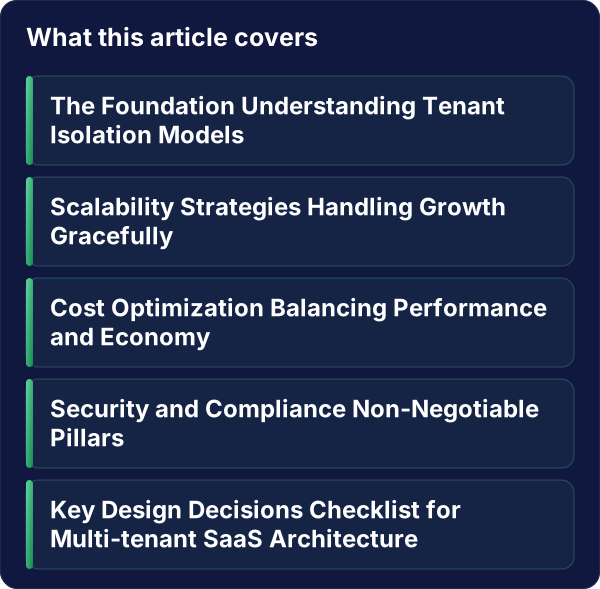
The Foundation: Understanding Tenant Isolation Models
The cornerstone of any multi-tenant SaaS architecture is how you isolate tenant data and resources. This decision has profound implications for security, compliance, performance, and development complexity. There are three primary models, each with its own set of advantages and disadvantages:
1. Separate Databases per Tenant
In this model, each tenant is provisioned with its own dedicated database.
- Pros:
- Strongest Isolation: Offers the highest level of data isolation, simplifying security and compliance efforts. Data breaches in one tenant’s database are unlikely to affect others.
- Simplified Customization: Easier to implement tenant-specific schema modifications or database-level customizations.
- Backup & Restore: Granular backup and restore operations are straightforward for individual tenants.
- Cons:
- Higher Infrastructure Costs: Managing and maintaining a large number of databases can significantly increase infrastructure expenses, especially for a growing tenant base.
- Operational Overhead: Provisioning, managing, and monitoring thousands of databases can be complex and resource-intensive.
- Resource Underutilization: Many databases might sit idle or underutilized, leading to wasted resources.
- Scalability Challenges: Scaling to tens of thousands or millions of tenants can become logistically difficult and expensive.
2. Shared Database, Separate Schemas per Tenant
This model utilizes a single database instance, but each tenant’s data is segregated into its own distinct schema within that database.
- Pros:
- Good Isolation: Provides a reasonable level of data isolation, preventing direct cross-tenant data access at the schema level.
- Cost-Effective: Generally more cost-effective than separate databases, as it reduces the number of database instances to manage.
- Easier Management: Centralized database management simplifies operations compared to managing individual databases.
- Cons:
- Database Limits: Some database systems have limitations on the number of schemas allowed.
- Performance Bottlenecks: A single database instance can become a performance bottleneck as the number of tenants and their data volume grow. Query performance can degrade due to shared resources.
- Noisy Neighbor Problem: A resource-intensive tenant can impact the performance of others sharing the same database.
- Customization Complexity: Implementing tenant-specific schema customizations can be more challenging.
3. Shared Database, Shared Schema with Tenant Identifier
This is the most common and often the most scalable approach for multi-tenant SaaS architecture. All tenants share a single database and a single schema. Tenant data is distinguished by a tenant_id column in relevant tables.
- Pros:
- Highest Scalability: Offers the greatest potential for scaling to a massive number of tenants.
- Lowest Infrastructure Costs: Minimizes infrastructure overhead by consolidating resources.
- Simplified Operations: Easier to manage and deploy updates across all tenants.
- Cons:
- Complex Data Isolation: Requires rigorous application-level logic to ensure data is always filtered by
tenant_id. This is the most critical security aspect. - Noisy Neighbor Problem: Still susceptible to performance issues if one tenant consumes disproportionate resources.
- Complex Customization: Tenant-specific customizations can be very difficult to implement and manage.
- Backup & Restore Challenges: Performing tenant-specific backups and restores can be complex.
- Complex Data Isolation: Requires rigorous application-level logic to ensure data is always filtered by
Key Metric to Track: When evaluating isolation models, monitor Tenant Isolation Breach Incidents (aiming for zero) and Average Tenant Query Latency.
Scalability Strategies: Handling Growth Gracefully
A core promise of SaaS is scalability. Your multi-tenant SaaS architecture must be designed to handle increasing numbers of tenants and growing data volumes without compromising performance or availability.
Horizontal vs. Vertical Scaling
- Vertical Scaling: Increasing the resources (CPU, RAM, storage) of a single server. This is often a quick fix but has hard limits and can lead to single points of failure.
- Horizontal Scaling: Adding more machines or instances to distribute the load. This is crucial for multi-tenant systems.
Scaling Strategies for Multi-tenant Systems
- Database Scaling:
- Read Replicas: Distribute read traffic across multiple read-only database instances.
- Sharding: Partitioning your database horizontally based on a shard key (often
tenant_id). This distributes data and load across multiple database servers. While powerful, sharding adds significant complexity. - Connection Pooling: Efficiently manage database connections to reduce overhead.
- Application Layer Scaling:
- Stateless Services: Design your application services to be stateless, allowing you to spin up and down instances easily.
- Load Balancing: Distribute incoming traffic across multiple application instances.
- Microservices Architecture: Breaking down your application into smaller, independent services can allow you to scale specific components that are experiencing high load.
- Caching: Implement caching at various levels (application, database, CDN) to reduce the load on your backend systems and improve response times.
Key Metrics to Track: Application Response Time, Database Throughput (Queries Per Second), and Server Utilization. Aim to maintain low latency and high throughput as tenant count increases.
Cost Optimization: Balancing Performance and Economy
One of the primary drivers for adopting a multi-tenant SaaS architecture is cost efficiency. However, poorly designed systems can quickly become expensive to operate.
Shared Resources, Shared Savings
The fundamental cost advantage comes from sharing infrastructure. A single instance serving many tenants is inherently cheaper than deploying separate instances for each.
Areas for Cost Optimization
- Resource Provisioning: Accurately forecast resource needs to avoid over-provisioning. Utilize auto-scaling features to dynamically adjust resources based on demand.
- Database Optimization:
- Efficient Queries: Optimize SQL queries to minimize CPU and I/O usage.
- Indexing: Proper indexing is crucial for performance and can reduce the need for more powerful hardware.
- Data Archiving/Tiering: Move older, less frequently accessed data to cheaper storage tiers.
- Cloud Provider Choices: Select cloud services that offer cost-effective options for your specific needs (e.g., reserved instances, spot instances for non-critical workloads).
- Code Efficiency: Well-written, efficient code uses fewer resources, directly translating to lower operational costs.
- Monitoring and Alerting: Implement comprehensive monitoring to identify resource leaks or inefficiencies early.
Key Metrics to Track: Cost Per Tenant, Infrastructure Spend vs. Revenue, and Resource Utilization Rate.
Security and Compliance: Non-Negotiable Pillars
In a multi-tenant environment, security is paramount. A breach affecting one tenant can have devastating consequences for your reputation and business.
Tenant Data Security
- Access Control: Implement robust role-based access control (RBAC) at the application level to ensure users can only access data belonging to their tenant.
- Data Encryption: Encrypt data at rest and in transit. Consider tenant-specific encryption keys for an extra layer of security.
- Auditing: Maintain detailed audit logs of all access and modification activities to track who did what and when.
- Input Validation: Sanitize all user inputs to prevent injection attacks.
Compliance Considerations
- GDPR, CCPA, HIPAA: Depending on your target markets and the type of data you handle, you’ll need to ensure your multi-tenant SaaS architecture complies with relevant data privacy regulations. This often dictates the level of isolation required.
- Certifications: Pursuing certifications like SOC 2 or ISO 27001 can build trust with enterprise clients.
The “Noisy Neighbor” Problem in Security
Beyond resource contention, the “noisy neighbor” problem can also manifest in security. A compromised tenant might attempt to exploit vulnerabilities to access other tenants’ data. Strict application-level controls are your primary defense.
Key Metrics to Track: Number of Security Incidents, Time to Detect and Respond to Incidents, and Compliance Audit Success Rate.
Key Design Decisions Checklist for Multi-tenant SaaS Architecture
When embarking on or refining your multi-tenant SaaS architecture, consider the following critical decision points:
- Tenant Isolation Model:
- Separate Databases?
- Separate Schemas?
- Shared Schema with Tenant ID?
- Decision Driver: Security, compliance, cost, complexity, scalability needs.
- Data Storage Strategy:
- Relational Databases (SQL)?
- NoSQL Databases?
- Hybrid approaches?
- Decision Driver: Data structure, query patterns, scalability requirements.
- Tenant Provisioning and Onboarding:
- Automated provisioning workflows?
- Tenant-specific configurations during onboarding?
- Decision Driver: Time-to-market, operational efficiency.
- Scalability Plan:
- Horizontal vs. Vertical scaling strategy?
- Database sharding plan?
- Caching strategy?
- Decision Driver: Expected growth, performance targets.
- Security Framework:
- Authentication and Authorization mechanisms?
- Data encryption policies?
- Auditing and logging strategy?
- Decision Driver: Regulatory requirements, threat model.
- Cost Management Strategy:
- Resource monitoring and auto-scaling?
- Database optimization techniques?
- Cloud provider cost-saving measures?
- Decision Driver: Profitability targets, operational budget.
- Tenant Customization Needs:
- How much customization is required per tenant?
- Can customizations be handled via configuration or require schema changes?
- Decision Driver: Product differentiation, customer demands.
- Monitoring and Alerting:
- What KPIs will be tracked for performance, security, and cost?
- What alerting mechanisms will be in place?
- Decision Driver: Operational visibility, proactive issue resolution.
Conclusion: Building for the Future with Robust Multi-tenant SaaS Architecture
Mastering multi-tenant SaaS architecture is a continuous journey, not a destination. The decisions you make today will shape your product’s ability to scale, remain secure, and operate cost-effectively tomorrow. By carefully considering tenant isolation, implementing smart scalability strategies, prioritizing cost optimization, and embedding security and compliance from the outset, you can build a resilient and competitive SaaS offering.
At Alken, we specialize in helping product leaders and CTOs navigate these complex architectural challenges. Our expertise in designing and implementing scalable, secure, and cost-efficient multi-tenant SaaS architecture solutions can accelerate your time to market and ensure your platform is built for long-term success.
Ready to build a multi-tenant SaaS solution that stands out?
Contact us today at info@alken.dev to discuss your architectural needs.