Data strategy in SaaS: make better decisions with less noise
Unlock data-driven growth for your SaaS. Learn how a robust product data strategy leads to smarter decisions and less noise.

In the fast-paced world of Software-as-a-Service (SaaS), data is no longer a luxury; it’s the lifeblood of innovation, customer retention, and sustainable growth. Yet, many product leaders, CTOs, and technology teams find themselves drowning in a sea of information, struggling to extract actionable insights. The culprit? A lack of a coherent SaaS product data strategy.
Without a clear framework for collecting, analyzing, and leveraging product data, your organization risks making decisions based on gut feeling rather than empirical evidence. This leads to wasted resources, missed opportunities, and ultimately, a product that fails to resonate with its target market. This article will guide you through building a robust SaaS product data strategy, enabling you to cut through the noise and make informed, impactful decisions.
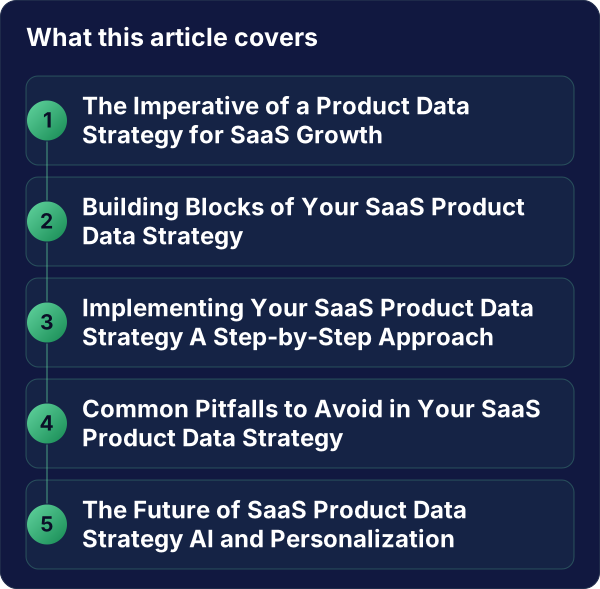
The Imperative of a Product Data Strategy for SaaS Growth
The digital landscape is characterized by rapid iteration and fierce competition. For SaaS companies, understanding user behavior, product performance, and market trends is paramount. A well-defined SaaS product data strategy acts as your compass, guiding you through this complexity. It’s not just about collecting data; it’s about creating a system that transforms raw information into strategic assets.
Consider the core objectives of any SaaS business:
- Acquisition: Attracting new users.
- Activation: Ensuring users experience the core value proposition.
- Retention: Keeping users engaged and subscribed.
- Revenue: Monetizing your product effectively.
- Referral: Encouraging users to advocate for your product.
Each of these stages is heavily influenced by data. Without a strategy, you’re essentially flying blind, unable to pinpoint what’s working, what’s not, and where to focus your limited resources.
Building Blocks of Your SaaS Product Data Strategy
A successful SaaS product data strategy is built on several foundational pillars. Neglecting any of these can undermine your entire data initiative.
1. Defining Clear Objectives and KPIs
Before you collect a single byte of data, you must understand why you are collecting it. What business questions are you trying to answer? What problems are you trying to solve? Your data strategy should be directly aligned with your overarching business goals.
Key questions to ask:
- What are our top 3 business priorities for the next quarter/year?
- Which user behaviors correlate with high customer lifetime value (CLTV)?
- What are the key friction points in our user onboarding process?
- How can we reduce churn by X%?
Once objectives are defined, establish Key Performance Indicators (KPIs) that will measure progress. These should be SMART (Specific, Measurable, Achievable, Relevant, Time-bound).
Examples of actionable KPIs for SaaS product data:
- Customer Acquisition Cost (CAC): Total marketing and sales spend divided by the number of new customers acquired.
- Customer Lifetime Value (CLTV): Average revenue per user multiplied by average customer lifespan. A healthy CLTV:CAC ratio (ideally 3:1 or higher) indicates sustainable growth.
- Monthly Active Users (MAU) / Daily Active Users (DAU): Measures user engagement. The MAU/DAU ratio can indicate stickiness.
- Churn Rate: The percentage of customers who stop using your service over a given period.
- Net Promoter Score (NPS): Measures customer loyalty and satisfaction.
- Feature Adoption Rate: The percentage of users who use a specific feature.
- Time to Value (TTV): The time it takes for a new user to experience the core benefit of your product.
2. Data Collection and Governance
This is where the rubber meets the road. A robust SaaS product data strategy requires a systematic approach to data collection, ensuring accuracy, consistency, and compliance.
Data Sources
Identify all potential sources of product data:
- Product Usage Data: Clickstream data, feature usage, session duration, error logs.
- User Feedback: Surveys, in-app feedback widgets, support tickets, NPS responses.
- CRM Data: Customer demographics, sales interactions, contract details.
- Marketing Automation Data: Campaign engagement, lead scoring.
- Financial Data: Subscription revenue, payment history.
Data Instrumentation
Ensure your product is properly instrumented to capture the necessary events. This involves implementing tracking codes, event logging, and defining clear event schemas. Tools like Segment, Amplitude, Mixpanel, or even custom-built solutions are crucial here.
Data Governance
Establish clear policies and procedures for data management:
- Data Ownership: Who is responsible for each data set?
- Data Quality: Processes for ensuring data accuracy and completeness.
- Data Security and Privacy: Compliance with regulations like GDPR, CCPA, and ensuring data is protected.
- Data Lineage: Understanding where data comes from and how it transforms.
3. Data Infrastructure and Tooling
The right infrastructure and tools are essential for effectively processing, storing, and analyzing your product data.
Data Warehouse/Lake
A centralized repository for all your data is critical. This could be a data warehouse (for structured data) or a data lake (for raw, unstructured data), or a combination (data lakehouse). Popular choices include Snowflake, BigQuery, Redshift, or Databricks.
ETL/ELT Tools
Tools to Extract, Transform, and Load (ETL) or Extract, Load, and Transform (ELT) data from various sources into your central repository. Examples include Fivetran, Stitch, or custom scripts.
Business Intelligence (BI) and Analytics Platforms
These tools allow you to visualize data, create dashboards, and perform ad-hoc analysis. Tableau, Power BI, Looker, and Metabase are common choices.
Machine Learning (ML) and AI Tools
For more advanced analytics, such as predictive modeling (e.g., churn prediction) or anomaly detection, you’ll need ML platforms and libraries (e.g., Python with scikit-learn, TensorFlow, cloud-based ML services).
4. Data Analysis and Interpretation
Collecting data is only half the battle. The real value comes from analyzing it to derive actionable insights.
Descriptive Analytics
Understanding what happened. This involves looking at historical data to identify trends, patterns, and anomalies. For example, analyzing feature adoption rates over the past quarter.
Diagnostic Analytics
Understanding why it happened. This delves deeper to find the root causes of observed trends. For example, why did feature X adoption suddenly drop? Was it a bug, a UI change, or a competitor launch?
Predictive Analytics
Forecasting what might happen. Using historical data to predict future outcomes. Examples include predicting which customers are at risk of churning or forecasting future revenue.
Prescriptive Analytics
Recommending what action to take. This is the most advanced form, suggesting specific actions to achieve desired outcomes. For example, recommending personalized onboarding flows for at-risk users.
5. Data Democratization and Actionability
Insights are useless if they remain siloed within the data team. A key component of a strong SaaS product data strategy is making data accessible and actionable for all relevant stakeholders.
Self-Service Analytics
Empower product managers, marketers, and customer success teams to access and analyze data relevant to their roles without constant reliance on engineers or analysts.
Dashboards and Reporting
Create clear, concise dashboards that highlight key metrics and trends for different teams. These should be regularly reviewed and updated.
Cross-Functional Collaboration
Foster a culture where data is discussed and debated across departments. Product, engineering, marketing, and sales should collaborate on interpreting data and defining next steps.
Feedback Loops
Ensure that insights derived from data are fed back into the product development lifecycle, informing roadmap decisions and feature prioritization.
Implementing Your SaaS Product Data Strategy: A Step-by-Step Approach
Transitioning to a data-driven organization requires a structured approach. Here’s a practical roadmap:
Step 1: Assess Your Current State
- Audit existing data sources and tools: What do you have? What’s missing?
- Identify data gaps: What critical data are you not collecting?
- Evaluate current data literacy: How comfortable are your teams with data?
- Define your “North Star” metric: What single metric best represents your product’s success?
Step 2: Define Your Strategic Goals
- Align with business objectives: What do you want to achieve with data? (e.g., reduce churn, increase conversion, improve user engagement).
- Prioritize use cases: Which problems will data solve first?
- Set clear, measurable KPIs: Define how you’ll track success.
Step 3: Design Your Data Architecture
- Choose your data stack: Select appropriate tools for collection, storage, processing, and analysis.
- Plan your data model: How will data be structured for efficient querying?
- Establish data governance policies: Define rules for data quality, security, and privacy.
Step 4: Implement Data Collection and Instrumentation
- Instrument your product: Ensure all relevant user actions are tracked.
- Integrate data sources: Connect your product, CRM, marketing, and other data streams.
- Clean and validate data: Implement processes for data quality assurance.
Step 5: Build Analytics Capabilities
- Develop core dashboards: Create visualizations for key KPIs.
- Train your teams: Equip stakeholders with the skills to interpret data.
- Establish reporting cadences: Define how often reports will be generated and reviewed.
Step 6: Foster a Data-Driven Culture
- Promote data literacy: Encourage continuous learning and experimentation.
- Democratize access: Make data accessible and understandable for all.
- Celebrate data-informed decisions: Recognize and reward teams for using data effectively.
- Create feedback loops: Ensure data insights drive product and business improvements.
Common Pitfalls to Avoid in Your SaaS Product Data Strategy
Even with the best intentions, several common pitfalls can derail your SaaS product data strategy:
- “Boiling the Ocean”: Trying to collect and analyze everything at once. Start with a few high-impact use cases.
- Lack of Executive Buy-in: Without support from leadership, data initiatives often falter.
- Data Silos: Data being trapped in individual departments or tools, preventing a holistic view.
- Poor Data Quality: Inaccurate or incomplete data leads to flawed insights and bad decisions.
- Focusing on Vanity Metrics: Tracking metrics that look good but don’t drive business value (e.g., total sign-ups without considering activation or retention).
- Ignoring User Feedback: Data is not just numbers; qualitative feedback is crucial for context.
- Tool Overload: Adopting too many tools without a clear integration strategy.
The Future of SaaS Product Data Strategy: AI and Personalization
As AI and machine learning technologies mature, they are becoming increasingly integral to effective SaaS product data strategy.
- Predictive Churn Analysis: AI can identify users at high risk of churning with greater accuracy, allowing for proactive intervention.
- Personalized User Experiences: Leveraging data to tailor product features, content, and communication to individual user needs and preferences.
- Automated Anomaly Detection: AI can automatically flag unusual patterns in usage or performance, alerting teams to potential issues before they escalate.
- Intelligent Feature Prioritization: ML models can analyze user behavior and market trends to recommend which features will have the greatest impact on growth and retention.
Embracing these advanced capabilities will allow SaaS companies to move beyond reactive analysis to proactive, predictive, and prescriptive decision-making, driving unprecedented levels of efficiency and customer satisfaction.
Conclusion: From Data Overload to Data Clarity
In the competitive SaaS landscape, a well-defined SaaS product data strategy is not optional; it’s a prerequisite for success. By focusing on clear objectives, robust data governance, the right infrastructure, and fostering a data-driven culture, you can transform your organization from being overwhelmed by data to being empowered by it.
This journey requires a strategic vision and meticulous execution. At Alken, we specialize in helping SaaS companies navigate the complexities of data strategy, from defining your core metrics to implementing cutting-edge analytics solutions. We help you cut through the noise, identify actionable insights, and build a product that truly resonates with your users, driving sustainable growth and competitive advantage.
Ready to unlock the full potential of your product data? Let’s build a data strategy that fuels your SaaS success.
Contact us today at info@alken.dev to discuss how we can help you make better decisions with less noise.