REST vs GraphQL: when to choose each for your project
Practical comparison of REST and GraphQL. Technical and business criteria to pick the right API architecture for each type of project and team.
REST vs GraphQL: when to choose each for your project
Choosing between REST and GraphQL is not about technical fashion — it is about fit to the problem. Both are valid API architectures that solve different challenges. Using the wrong one has a real cost: unnecessary over-fetching, a proliferation of endpoints, or an adoption curve that slows down small teams.
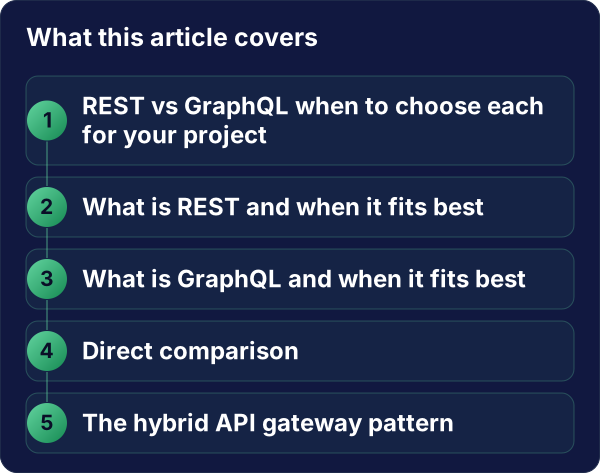
What is REST and when it fits best
REST (Representational State Transfer) models resources as URLs (/users, /orders/123) and uses standard HTTP methods (GET, POST, PUT, DELETE) to operate on them.
REST fits best when:
- The API will be consumed by multiple clients without special coupling (web, mobile, third parties)
- The team has limited GraphQL experience and delivery timelines are tight
- Resources are stable and well-defined — they do not change much once designed
- HTTP caching is critical (CDN, reverse proxy, idempotent responses)
- The API is public and needs standard tooling like OpenAPI/Swagger
REST has decades of maturity behind it. The problems of over-fetching (receiving fields you do not need) and under-fetching (needing several endpoints to assemble a view) are real but manageable with good resource design and semantic versioning.
What is GraphQL and when it fits best
GraphQL is a query language for APIs where the client defines exactly what data it wants. Instead of multiple endpoints, there is a single entry point and the client describes the shape of the response.
GraphQL fits best when:
- Different screens have very different data requirements (e.g. a card list vs a full detail view)
- Multiple clients exist (web, iOS, Android) with heterogeneous needs and you want to avoid maintaining platform-specific endpoints
- The domain is complex and data is highly relational (entity graphs)
- The frontend team needs to iterate on views without depending on backend changes
GraphQL eliminates over-fetching and enables rapid client-side iteration. But it introduces operational complexity: harder rate limiting, non-trivial HTTP caching, introspection tooling, and a real learning curve for teams coming exclusively from REST.
Direct comparison
| Criterion | REST | GraphQL |
|---|---|---|
| Learning curve | Low | Medium-high |
| HTTP caching | Native (GET) | Requires custom solution |
| Over-fetching | Possible | Eliminated by design |
| Multiple clients | Platform-specific endpoints | Single flexible endpoint |
| Contracts and types | OpenAPI/Swagger | SDL schema built-in |
| Debugging tooling | Mature | Still evolving |
| Performance on simple queries | Better | Parsing overhead |
The hybrid API gateway pattern
Most real-world systems are neither pure REST nor pure GraphQL. A common pattern is exposing REST to third parties (B2B integrations, webhooks, public consumers) and GraphQL to internal clients (dashboard, mobile app). The gateway acts as a boundary between the two worlds.
This architecture captures the best of both approaches: simplicity and caching for external consumers, flexibility for internal teams that need to iterate quickly.
Signs you are choosing for the wrong reasons
- “We use GraphQL because it sounds more modern” — Modernity is not an architecture criterion.
- “We use REST because we always have” — Inertia is not one either.
- “GraphQL will scale better” — In most systems, the bottleneck is the database or business logic, not the API protocol.
The right question is always: who consumes this API, how heterogeneous are their needs, and what is the team’s capacity to maintain it?
Conclusion
REST is the safe default for well-defined, public APIs or teams with less specialised experience. GraphQL delivers real value when clients have heterogeneous needs and the team has the experience to operate it correctly.
If your project has a single web app and four well-defined endpoints, REST with OpenAPI is more than enough. If the product has clients across multiple platforms with radically different views, GraphQL starts to justify itself.
Unsure which architecture fits your system? Alken designs and implements API integrations and automation with both technologies — from contract design to production monitoring.