Software total cost of ownership: how to calculate it without blind spots
Unlock the true Software Total Cost of Ownership (TCO). Calculate it accurately to avoid hidden costs and make smarter build vs. buy decisions.
In the fast-paced world of B2B software for agencies and startups, making informed decisions about technology investments is paramount. Too often, the focus remains solely on the upfront purchase price, leading to significant budget overruns and strategic missteps down the line. This is where understanding the software total cost of ownership (TCO) becomes not just beneficial, but essential.
For product leaders, CTOs, and technology teams, a comprehensive TCO analysis provides a clear, data-driven picture of the true financial implications of any software solution. It moves beyond the sticker price to encompass all direct and indirect costs associated with acquiring, implementing, using, and eventually retiring a software asset. Ignoring this holistic view is akin to navigating a minefield with your eyes closed – the hidden dangers can be costly.
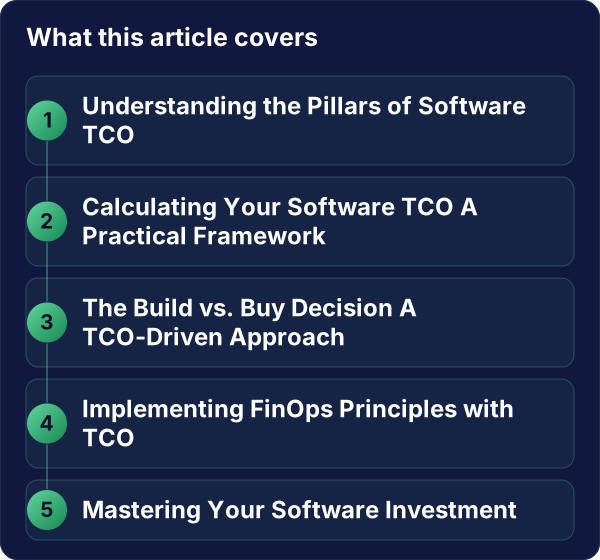
This article will guide you through calculating your software TCO without blind spots, equipping you with the knowledge to make smarter build vs. buy decisions, optimize your FinOps strategy, and ultimately drive greater value from your technology investments.
Understanding the Pillars of Software TCO
The software total cost of ownership is a multifaceted concept. To calculate it effectively, we must break it down into its core components. These pillars represent the lifecycle of a software solution, from initial acquisition to its eventual decommissioning.
1. Acquisition Costs: The Tip of the Iceberg
These are the most visible costs, often the first ones considered. However, even here, there are nuances to explore beyond the headline price.
- License Fees: This includes perpetual licenses, subscription fees (SaaS), and any tiered pricing based on user count, features, or usage.
- Hardware Costs: If the software requires specific hardware, servers, or infrastructure upgrades, these must be factored in. For on-premise solutions, this is a significant component.
- Implementation & Setup Fees: This covers professional services, consulting fees, and any third-party vendor costs associated with getting the software up and running.
- Initial Training Costs: The expense of training your team to effectively use the new software.
2. Operational Costs: The Ongoing Investment
These are the recurring expenses that keep the software functioning and delivering value over its lifespan. They often represent the largest portion of the TCO.
- Subscription/Maintenance Fees: For SaaS models, this is the ongoing subscription. For perpetual licenses, it’s the annual maintenance and support fees.
- Personnel Costs:
- IT Staff Time: The hours your internal IT team spends on administration, patching, updates, troubleshooting, and system monitoring. This is a critical, often underestimated, cost.
- End-User Time: While not a direct cash outlay, the productivity lost due to inefficient software, complex workflows, or the need for workarounds can be quantified as an opportunity cost.
- Infrastructure & Hosting Costs: For cloud-based solutions, this includes compute, storage, and network costs. For on-premise, it’s electricity, cooling, and physical space for servers.
- Support & Maintenance: Costs associated with vendor support contracts, bug fixes, and ongoing system maintenance.
- Integration Costs: Expenses related to integrating the software with other existing systems (e.g., CRM, ERP, marketing automation). This can be a significant ongoing cost if integrations are complex or require frequent updates.
3. Hidden Costs: The Blind Spots to Avoid
These are the expenses that are easily overlooked but can significantly inflate the software total cost of ownership. Proactive identification is key.
- Customization & Development: Any bespoke development or heavy customization required to meet specific business needs. This can lead to vendor lock-in and increased maintenance complexity.
- Downtime & Performance Issues: The financial impact of system outages, slow performance, or data loss. This includes lost revenue, reduced productivity, and potential reputational damage.
- Security Breaches & Compliance: The cost of a data breach, including incident response, legal fees, fines, and reputational repair. Ensuring compliance with regulations (GDPR, CCPA, etc.) can also incur significant costs for audits and necessary adjustments.
- Upgrade & Migration Costs: The expense and effort involved in future upgrades, version migrations, or even complete system replacements. These are often larger than anticipated.
- Training & Onboarding for New Hires: The recurring cost of training new employees on the software throughout its lifecycle.
- Opportunity Cost: The value of what your team could be doing if they weren’t spending time on inefficient software or dealing with technical issues. This is a crucial metric for product leaders.
4. End-of-Life Costs: The Final Chapter
When a software solution reaches the end of its useful life, there are still costs associated with its retirement.
- Data Migration & Archiving: The expense of migrating data to a new system or archiving it for compliance purposes.
- Decommissioning: The cost of safely shutting down and removing the old system and its associated infrastructure.
- Disposal of Hardware: If applicable, the cost of securely disposing of old hardware.
Calculating Your Software TCO: A Practical Framework
To effectively calculate your software total cost of ownership, a structured approach is necessary. This framework helps ensure all relevant costs are identified and quantified.
Step 1: Define the Scope and Time Horizon
Before diving into numbers, clearly define:
- The Software in Question: Is it a new purchase, an existing system, or a custom build?
- The Time Horizon: Typically, a 3-5 year period is used for TCO calculations, but this can be adjusted based on the expected lifespan of the software.
- The Key Stakeholders: Who will be involved in the data collection and decision-making?
Step 2: Identify and Quantify All Cost Categories
This is where you meticulously gather data for each of the TCO pillars discussed earlier.
- Direct Costs:
- Gather Quotes: For licenses, subscriptions, implementation services, and support contracts.
- Estimate Hardware: Based on vendor specifications and internal IT assessments.
- Quantify Personnel Time:
- IT Admin Time: Track actual hours spent or estimate based on similar systems. Multiply by the loaded hourly rate of your IT staff (salary + benefits + overhead).
- End-User Time: This is harder to quantify directly but can be estimated by observing workflows or conducting user surveys.
- Indirect Costs:
- Estimate Downtime Impact: Calculate lost revenue or productivity during historical outages.
- Research Security Incident Costs: Use industry benchmarks for data breach costs.
- Factor in Compliance Efforts: Estimate costs for audits, legal reviews, and necessary system adjustments.
- Estimate Future Upgrade Costs: Based on vendor roadmaps and historical upgrade expenses.
Example: For a SaaS CRM, the TCO calculation over 3 years might include:
- Acquisition: Annual subscription fees ($X/user/year * Y users * 3 years)
- Operational:
- IT Admin time for user management, reporting, and integration maintenance (Z hours/month * $HourlyRate * 12 months * 3 years)
- Integration costs with marketing automation platform (one-time setup + ongoing API maintenance)
- Training for new hires (estimated per hire * projected hires)
- Hidden Costs: Estimated cost of potential data breach ($A) + cost of downtime during planned maintenance ($B).
Step 3: Incorporate the Time Value of Money (Discount Rate)
Future costs are worth less than present costs. Applying a discount rate (often the company’s Weighted Average Cost of Capital - WACC) to future expenses provides a Net Present Value (NPV) of the TCO. This is crucial for comparing investments with different payout structures.
Step 4: Perform Sensitivity Analysis
No TCO calculation is perfect. Conduct sensitivity analysis by varying key assumptions (e.g., user growth, support costs, downtime frequency) to understand the range of potential TCO outcomes. This helps identify the most critical cost drivers and risks.
The Build vs. Buy Decision: A TCO-Driven Approach
The software total cost of ownership is a cornerstone of the build vs. buy decision. While a custom build might seem appealing for unique requirements, its TCO can often be significantly higher than off-the-shelf solutions when all factors are considered.
Build Considerations:
- Initial Development Costs: This is just the beginning. Factor in ongoing development, testing, and QA resources.
- Maintenance & Support: Who will maintain and support the custom solution? This requires dedicated internal resources or costly external contracts.
- Scalability & Future-Proofing: Building for scale and anticipating future needs adds complexity and cost.
- Talent Acquisition & Retention: Hiring and retaining skilled developers for a niche internal product can be challenging and expensive.
- Opportunity Cost: The resources (time, money, talent) spent building an internal solution could have been used for core product development or market expansion.
Buy Considerations:
- Vendor Expertise & Roadmap: Established vendors invest heavily in R&D, ensuring their product is up-to-date and scalable.
- Faster Time-to-Market: Off-the-shelf solutions can be implemented much quicker, allowing you to realize value sooner.
- Lower Initial Risk: The vendor bears much of the development risk.
- Predictable Costs (with careful analysis): While hidden costs exist, a thorough TCO analysis can make costs more predictable than a custom build.
When to Build: Building is often justified when the core functionality is a significant competitive differentiator, requires highly proprietary logic, or when off-the-shelf solutions are fundamentally inadequate and the long-term strategic advantage outweighs the TCO.
When to Buy: Buying is generally the more cost-effective and less risky option for solutions that address common business needs, where customization is limited, or when the focus is on rapid deployment and iteration.
Implementing FinOps Principles with TCO
FinOps, the practice of bringing financial accountability to the variable spend model of the cloud, is deeply intertwined with software total cost of ownership. A robust TCO framework is essential for effective FinOps.
Key FinOps Metrics and TCO:
- Cost Allocation: Accurately attributing software costs to specific teams, projects, or business units is crucial. TCO helps in understanding the full cost picture for these allocations.
- Budgeting & Forecasting: A detailed TCO model provides a more accurate basis for budgeting and forecasting software spend, reducing the likelihood of unexpected overruns.
- Optimization Opportunities: By dissecting the TCO, you can identify areas of inefficiency. For example, underutilized licenses, excessive cloud infrastructure spend, or high IT support overhead.
- Showback & Chargeback: TCO data empowers you to effectively show costs back to business units and, where appropriate, charge them back, fostering cost awareness and accountability.
- Investment Decisions: TCO analysis informs investment decisions. Should we invest more in optimizing our current solution, or is it time to look for a more cost-effective alternative?
FinOps Checklist for TCO Integration:
- Establish a Cross-Functional FinOps Team: Include representatives from Finance, Engineering, and Product.
- Implement Robust Cost Tagging: Ensure all cloud resources and software licenses are tagged appropriately for accurate cost allocation.
- Regularly Review TCO Models: Update TCO calculations quarterly or semi-annually to reflect actual spend and evolving needs.
- Automate Cost Monitoring and Alerting: Set up alerts for cost anomalies and budget deviations.
- Foster a Culture of Cost Awareness: Educate teams on the impact of their technology choices on the overall software total cost of ownership.
- Benchmark TCO Against Industry Standards: Compare your software TCO to similar organizations to identify potential areas for improvement.
- Prioritize Optimization Efforts: Focus on the cost drivers with the biggest impact on your TCO.
Conclusion: Mastering Your Software Investment
Understanding and accurately calculating your software total cost of ownership is not a one-time exercise; it’s an ongoing strategic imperative. By moving beyond the superficial and delving into all direct, indirect, and hidden costs, you gain the clarity needed to make superior build vs. buy decisions, optimize your FinOps practices, and ensure your technology investments deliver maximum ROI.
At Alken, we specialize in helping B2B software companies, agencies, and startups navigate these complex financial landscapes. We understand the nuances of software acquisition, implementation, and ongoing management, and we can help you uncover those critical blind spots in your TCO calculations.
Don’t let hidden costs derail your growth. Let us help you achieve true financial clarity and make data-driven technology decisions that propel your business forward.
Ready to unlock the true cost of your software and make smarter investment choices? Contact us today at info@alken.dev.