Stripe + ERP integration: avoid billing and accounting mismatches
Unlock seamless Stripe + ERP integration to eliminate billing & accounting discrepancies. Boost efficiency & accuracy.
In today’s fast-paced digital economy, businesses rely on a robust financial infrastructure to thrive. For SaaS companies, e-commerce platforms, and any business processing recurring payments, Stripe has become a de facto standard for payment processing. However, the real magic happens when Stripe’s powerful payment capabilities are seamlessly integrated with your Enterprise Resource Planning (ERP) system. This Stripe ERP integration is not just a technical convenience; it’s a strategic imperative that can prevent costly billing and accounting mismatches, streamline operations, and provide a single source of truth for your financial data.
For product leaders, CTOs, and technology teams, understanding the nuances of this integration is crucial. Without it, you risk manual data entry errors, delayed financial reporting, inaccurate revenue recognition, and a significant drain on valuable resources. This article will delve into why a robust Stripe ERP integration is essential, the common pitfalls to avoid, and how to achieve a seamless, automated flow of financial data.
The Growing Complexity of Modern Payment Workflows
As businesses scale, their payment processing needs become increasingly sophisticated. Stripe excels at handling a multitude of payment methods, subscriptions, marketplaces, and global transactions. Yet, the data generated by Stripe needs to be reconciled with your core business systems – your ERP. This includes customer data, transaction details, refunds, disputes, and subscription changes.
Without a direct integration, finance teams often resort to manual data extraction and re-entry. This process is not only time-consuming but also highly prone to human error. Imagine the cascading effect of a single incorrect invoice entry: it can lead to incorrect revenue recognition, flawed financial statements, and ultimately, poor business decisions. The complexity is amplified when dealing with:
- Subscription Management: Recurring billing requires accurate tracking of subscription lifecycles, upgrades, downgrades, and cancellations.
- Global Transactions: Handling multiple currencies, tax regulations, and local payment preferences adds layers of complexity.
- Marketplace Operations: If you operate a marketplace, managing payouts to sellers and reconciling transactions becomes a significant challenge.
- Refunds and Disputes: Processing refunds and managing chargebacks efficiently is critical for customer satisfaction and financial health.
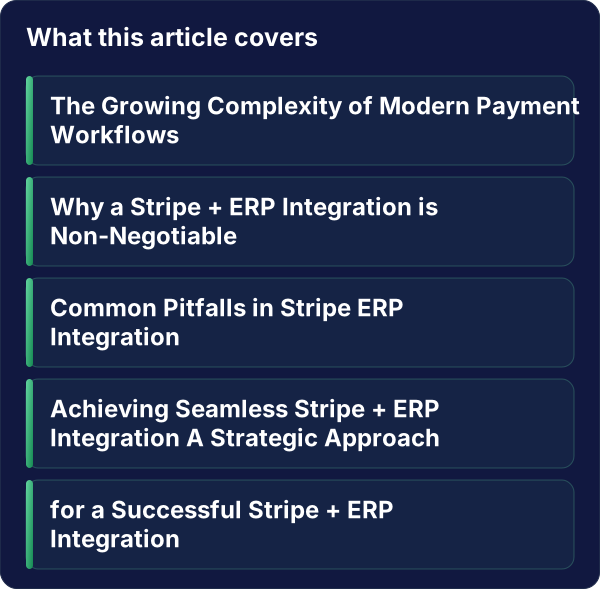
Why a Stripe + ERP Integration is Non-Negotiable
The core benefit of a Stripe ERP integration lies in its ability to create a unified, automated financial ecosystem. This eliminates the friction points that arise from disparate systems and manual processes. Let’s break down the key advantages:
1. Eliminating Billing and Accounting Mismatches
This is the most immediate and impactful benefit. When Stripe transactions are automatically fed into your ERP, you ensure that your accounting records accurately reflect your payment processing activities.
- Real-time Reconciliation: Instead of waiting for month-end reports, you can achieve near real-time reconciliation of Stripe revenue against your general ledger. This dramatically improves financial visibility.
- Reduced Data Entry Errors: Automation minimizes the risk of typos, missed entries, or incorrect data transfers that plague manual processes.
- Accurate Revenue Recognition: Properly integrated systems ensure that revenue is recognized according to accounting standards (e.g., ASC 606), which is vital for SaaS businesses with subscription revenue. This means correctly accounting for deferred revenue and recognizing revenue over the service period.
- Streamlined Audits: Having a clear, automated audit trail from payment to accounting entry makes internal and external audits significantly smoother and less resource-intensive.
2. Enhancing Operational Efficiency and Reducing Costs
The time saved by automating data transfer is substantial. This allows your finance and operations teams to focus on higher-value activities.
- Faster Month-End Close: A significant KPI for finance departments is the speed of their month-end close. Automation directly contributes to reducing this cycle time, allowing for quicker financial reporting and decision-making.
- Reduced Manual Labor: Eliminating repetitive data entry frees up personnel to focus on analysis, strategy, and customer service. This translates directly into cost savings.
- Improved Cash Flow Management: With accurate, up-to-date financial data, you gain better insights into your cash flow, enabling more effective forecasting and management.
- Scalability: As your business grows, manual processes become unsustainable. An integrated system scales with your business, handling increased transaction volumes without a proportional increase in manual effort.
3. Gaining Deeper Business Insights
A unified view of your financial data unlocks powerful analytical capabilities.
- Holistic Financial Reporting: Combine Stripe payment data with other ERP modules (e.g., inventory, project management) to get a comprehensive view of your business performance.
- Customer Lifetime Value (CLV) Analysis: Accurate tracking of customer payments and subscription history within your ERP, linked to Stripe data, allows for more precise CLV calculations.
- Profitability Analysis: Understand the true profitability of different products, services, or customer segments by accurately attributing revenue and associated costs.
- Forecasting Accuracy: Better data quality leads to more reliable financial forecasts, enabling more strategic planning.
Common Pitfalls in Stripe ERP Integration
While the benefits are clear, achieving a successful Stripe ERP integration isn’t always straightforward. Many businesses encounter common roadblocks:
1. Lack of a Clear Integration Strategy
- Undefined Scope: Not clearly defining what data needs to be synchronized, how often, and in which direction (one-way vs. two-way sync).
- Choosing the Wrong Integration Method: Opting for point-to-point custom integrations that are difficult to maintain and scale, rather than using middleware or iPaaS solutions.
- Ignoring Data Mapping: Failing to properly map fields between Stripe and your ERP can lead to data corruption or misinterpretation.
2. Data Inconsistencies and Duplication
- Manual Data Entry: As mentioned, this is a primary source of errors.
- Multiple Data Sources: If customer or transaction data exists in multiple places without a single source of truth, synchronization becomes a nightmare.
- Lack of Data Validation: Not implementing checks to ensure data integrity before it’s transferred.
3. Underestimating Complexity and Maintenance
- One-Time Setup Illusion: Integrations require ongoing monitoring, updates, and maintenance, especially as Stripe or your ERP system evolve.
- Ignoring API Changes: Stripe and ERP systems frequently update their APIs. Failure to adapt can break the integration.
- Lack of Expertise: Trying to build and maintain complex integrations without the necessary technical skills can lead to costly failures.
4. Security and Compliance Concerns
- Handling Sensitive Data: Ensuring that payment data is handled securely and in compliance with regulations like PCI DSS is paramount.
- Access Control: Implementing proper access controls to prevent unauthorized access to financial data.
Achieving Seamless Stripe + ERP Integration: A Strategic Approach
To navigate these challenges and unlock the full potential of your Stripe ERP integration, a strategic and methodical approach is essential.
H3: Choosing the Right Integration Method
The method you choose will significantly impact the success, scalability, and maintainability of your integration.
- Native Connectors: Some ERP systems offer pre-built connectors for Stripe. These can be a good starting point but may lack the customization needed for complex workflows.
- iPaaS (Integration Platform as a Service) Solutions: Platforms like Zapier, Workato, or Boomi offer pre-built connectors and visual workflow builders. They are often more flexible and scalable than native connectors and can handle complex data transformations and multi-system integrations.
- Custom API Integrations: For highly specific or complex requirements, building a custom integration using Stripe’s and your ERP’s APIs might be necessary. This requires significant development resources and ongoing maintenance.
H3: Key Data Points for Synchronization
When planning your integration, prioritize synchronizing these critical data points:
- Customer Information: Ensure customer profiles are consistent across both systems.
- Transactions: All successful payments, refunds, and voids from Stripe should be recorded in your ERP.
- Invoices: Generate invoices in your ERP based on Stripe transaction data for a unified billing record.
- Subscription Details: For recurring payments, synchronize subscription status, renewal dates, and plan changes.
- Disputes and Chargebacks: Automate the recording of disputes and chargebacks to facilitate timely resolution and financial adjustments.
- Payouts: Reconcile Stripe payouts to your bank account with records in your ERP.
H3: The Importance of Data Mapping and Transformation
Accurate data mapping is the backbone of any successful integration.
- Field-Level Mapping: Define precisely which field in Stripe corresponds to which field in your ERP.
- Data Transformation Rules: Implement rules to transform data as needed. For example, converting Stripe’s internal IDs to your ERP’s customer IDs or formatting dates consistently.
- Error Handling and Logging: Establish robust error handling mechanisms to identify and resolve integration issues quickly. Log all integration activities for auditing purposes.
Checklist for a Successful Stripe + ERP Integration
Implementing a Stripe ERP integration requires careful planning and execution. Use this checklist to guide your process:
- Define Objectives: Clearly articulate the business goals for the integration (e.g., reduce manual errors by X%, speed up month-end close by Y days).
- Assess Current Systems: Understand your existing Stripe setup and your ERP’s capabilities and limitations.
- Identify Data Requirements: List all data points that need to be synchronized and their direction of flow.
- Choose Integration Method: Select the most appropriate method (iPaaS, custom, native) based on complexity, budget, and resources.
- Map Data Fields: Create a detailed data mapping document for all synchronized fields.
- Develop Transformation Rules: Define any necessary data transformations.
- Implement Security Measures: Ensure compliance with PCI DSS and other relevant security standards.
- Build and Test Thoroughly: Develop the integration and conduct rigorous testing with various scenarios (new customers, recurring payments, refunds, disputes).
- Plan for Deployment: Outline the deployment strategy, including a rollback plan if necessary.
- Establish Monitoring and Maintenance: Set up ongoing monitoring for errors and plan for regular maintenance and updates.
- Train Your Team: Ensure your finance and operations teams understand the new automated processes.
- Document Everything: Maintain comprehensive documentation of the integration architecture, data flows, and error handling procedures.
Conclusion: Future-Proofing Your Financial Operations
A robust Stripe ERP integration is no longer a luxury; it’s a necessity for businesses aiming for efficiency, accuracy, and scalability. By automating the flow of payment data between Stripe and your ERP, you eliminate manual errors, gain real-time financial visibility, and empower your teams to focus on strategic growth. The investment in a well-planned and executed integration pays dividends in reduced operational costs, improved decision-making, and a more resilient financial infrastructure.
At Alken, we specialize in building these critical bridges between your payment gateways and your core business systems. We understand the complexities of financial data synchronization and have a proven track record of delivering seamless Stripe ERP integration solutions that drive efficiency and accuracy for SaaS companies, e-commerce platforms, and growing startups.
Don’t let billing and accounting mismatches hinder your growth. Let us help you build a future-proof financial operation.
Ready to streamline your financial operations and eliminate costly discrepancies? Contact us today to discuss your Stripe + ERP integration needs.
[email protected]