Data governance for digital companies: a practical framework for lean teams
Master data governance for digital companies with a practical framework. Enhance data quality, ownership, and compliance for lean teams.
In today’s hyper-competitive digital landscape, data is no longer just a byproduct of operations; it’s the lifeblood of innovation, customer understanding, and strategic decision-making. For agile startups and forward-thinking digital agencies, harnessing this data effectively is paramount. However, as data volumes explode and complexity grows, the need for robust data governance for companies becomes undeniable. Without it, teams risk operating on flawed insights, facing compliance nightmares, and ultimately, hindering their growth potential.
This article provides a practical, actionable framework for implementing data governance within lean, digital-first organizations. We’ll cut through the jargon and focus on what truly matters: establishing clear ownership, ensuring data quality, and maintaining compliance, all while respecting the agility that defines your business.
The Imperative of Data Governance in the Digital Age
The digital economy thrives on data. From personalized customer experiences and predictive analytics to optimizing marketing spend and streamlining operations, data fuels every critical function. Yet, the very speed and iterative nature of digital businesses can inadvertently lead to data chaos. Without a structured approach to managing data, organizations face several critical risks:
- Inaccurate Decision-Making: If your data is inconsistent, incomplete, or outdated, the insights derived from it will be flawed. This can lead to misallocated resources, failed product launches, and missed market opportunities.
- Compliance Violations: With an ever-evolving regulatory landscape (GDPR, CCPA, etc.), non-compliance can result in hefty fines, reputational damage, and loss of customer trust.
- Operational Inefficiencies: Poor data quality leads to wasted time spent cleaning, reconciling, and validating information. This drains valuable engineering and product resources that could be focused on innovation.
- Security Vulnerabilities: Unmanaged data can become a security risk, making it harder to track access, identify breaches, and implement appropriate security measures.
- Stifled Innovation: When teams spend more time fighting data fires than leveraging data for new ideas, innovation grinds to a halt.
For lean teams, the challenge is to implement effective data governance for companies without creating bureaucratic overhead that slows down their agile processes. The key is to adopt a pragmatic, phased approach that scales with the organization.
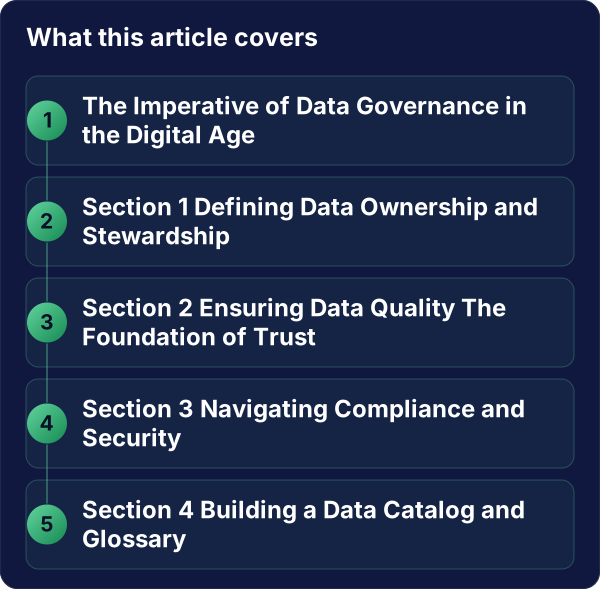
Section 1: Defining Data Ownership and Stewardship
At the heart of any effective data governance strategy lies the concept of ownership. In a lean environment, this doesn’t necessarily mean a dedicated, large data governance team. Instead, it involves assigning clear responsibilities for specific data domains.
H3: Identifying Data Domains
Start by identifying your critical data domains. These are logical groupings of data that serve specific business functions. Examples include:
- Customer Data: Information related to users, clients, and their interactions.
- Product Data: Details about your products, features, and their performance.
- Financial Data: Transactional, revenue, and cost information.
- Marketing Data: Campaign performance, lead generation, and engagement metrics.
- Operational Data: System logs, performance metrics, and infrastructure information.
H3: Assigning Data Owners and Stewards
Once domains are defined, assign data owners and data stewards.
- Data Owner: Typically a senior leader (e.g., Head of Product, CTO, VP of Marketing) responsible for the overall strategic direction, policy setting, and accountability for a specific data domain. They ensure the data aligns with business objectives.
- Data Steward: A subject matter expert within a team who is hands-on with the data. They are responsible for the day-to-day management of data quality, definition, and usage within their domain. For example, a Senior Product Manager might be the Data Owner for Product Data, while a Lead Data Analyst could be the Data Steward.
Key Responsibilities of Data Owners & Stewards:
- Defining Data Definitions and Standards: Ensuring consistent understanding and usage of data terms.
- Establishing Data Quality Rules: Setting benchmarks for accuracy, completeness, and timeliness.
- Managing Data Access and Security: Approving who can access what data and for what purpose.
- Resolving Data Issues: Acting as the point person for data-related problems within their domain.
- Championing Data Governance: Promoting best practices and awareness within their teams.
Metric to Track: Percentage of critical data domains with assigned owners and stewards. Aim for 100%.
Section 2: Ensuring Data Quality: The Foundation of Trust
High-quality data is non-negotiable. Without it, your analytics, AI models, and operational systems are built on a shaky foundation. For lean teams, the focus should be on proactive quality measures and efficient issue resolution.
H3: Establishing Data Quality Dimensions
Data quality can be assessed across several dimensions. For lean teams, prioritize the most impactful ones:
- Accuracy: Is the data correct and free from errors? (e.g., correct customer email addresses).
- Completeness: Is all necessary data present? (e.g., all required fields in a user profile).
- Consistency: Is data represented uniformly across different systems and touchpoints? (e.g., date formats, naming conventions).
- Timeliness: Is the data available when needed? (e.g., real-time analytics for customer behavior).
- Validity: Does the data conform to defined formats and constraints? (e.g., valid email address format).
H3: Implementing Data Quality Checks
Integrate data quality checks at various stages of the data lifecycle:
- Ingestion: Implement validation rules for data entering your systems. This can be done through API validation, schema enforcement, or basic data type checks.
- Transformation: During data processing and aggregation, run checks to ensure transformations are applied correctly and data integrity is maintained.
- Reporting & Analytics: Regularly profile your data to identify anomalies and deviations from expected patterns.
- Automated Monitoring: Set up automated alerts for data quality issues. For instance, trigger an alert if the number of new customer sign-ups drops by more than 50% overnight, indicating a potential data pipeline issue.
Example: A SaaS startup notices a high churn rate. Upon investigation, they discover that customer usage data is incomplete, making it impossible to accurately identify at-risk users. By implementing mandatory fields for usage tracking at the point of data entry and setting up automated alerts for missing usage data, they improve the completeness and accuracy of their churn prediction models, leading to more proactive customer retention efforts.
KPI to Track: Data Quality Score (a composite score based on accuracy, completeness, etc.), Percentage of Data Records Meeting Quality Standards.
Section 3: Navigating Compliance and Security
In the digital realm, compliance isn’t just a legal requirement; it’s a critical component of customer trust and business sustainability. Gobierno del dato empresas (data governance for companies) must inherently address regulatory adherence and data security.
H3: Understanding Relevant Regulations
Identify the data privacy and security regulations applicable to your business and your customer base. Common examples include:
- GDPR (General Data Protection Regulation): For companies processing personal data of EU residents.
- CCPA/CPRA (California Consumer Privacy Act/California Privacy Rights Act): For companies processing personal data of California residents.
- HIPAA (Health Insurance Portability and Accountability Act): For companies handling protected health information.
H3: Implementing Data Security Best Practices
- Access Control: Implement granular role-based access controls (RBAC) to ensure users only access data they absolutely need.
- Data Masking and Anonymization: For non-production environments or analytics where PII is not required, mask or anonymize sensitive data.
- Encryption: Encrypt data both in transit and at rest.
- Auditing and Monitoring: Regularly audit data access logs to detect suspicious activity.
H3: Data Retention and Deletion Policies
Define clear policies for how long different types of data are retained and establish secure deletion processes. This is crucial for compliance and for managing data storage costs.
Example: A fintech startup processing financial transactions must ensure compliance with PCI DSS. By implementing strong encryption for cardholder data, strict access controls for sensitive financial information, and a robust audit trail of all data access and modifications, they not only meet compliance requirements but also significantly reduce the risk of a data breach.
Metric to Track: Number of data privacy incidents, Compliance audit pass rates.
Section 4: Building a Data Catalog and Glossary
A common challenge in lean organizations is the tribal knowledge surrounding data. Without a centralized, accessible repository of information, understanding what data exists, where it resides, and what it means becomes a constant struggle. A data catalog and glossary address this.
H3: The Data Catalog: Your Data Inventory
A data catalog acts as a comprehensive inventory of your data assets. It should include:
- Data Source: Where the data originates (e.g., database, API, file).
- Data Location: Specific tables, files, or endpoints.
- Data Owner/Steward: Who is responsible for this data asset.
- Data Lineage: How the data flows from source to its current state.
- Usage Information: Who is using this data and for what purpose.
H3: The Data Glossary: A Common Language
A data glossary defines key business terms and their corresponding data elements. This ensures everyone in the organization speaks the same data language.
- Term: A business concept (e.g., “Active User”).
- Definition: A clear, concise explanation of the term.
- Business Rules: Any logic or criteria associated with the term.
- Technical Name: The actual name of the data element in your systems (e.g.,
users.is_active). - Related Terms: Links to other relevant glossary entries.
Example: A marketing agency uses different definitions for “Lead” across its sales and marketing teams. Implementing a data glossary that clearly defines “Lead” as “A prospect who has expressed interest in our services and provided contact information,” and links it to specific CRM fields, eliminates confusion. This leads to more accurate lead scoring and more efficient campaign targeting, improving conversion rates by an estimated 15%.
Metric to Track: Percentage of critical data assets documented in the catalog, Number of glossary terms defined and adopted.
Section 5: Implementing a Phased Approach: Strategy for Lean Teams
For lean teams, a “big bang” data governance rollout is often a recipe for failure. A phased, iterative approach is far more effective.
H3: Phase 1: Foundation & Prioritization
- Identify Critical Data: Start with the data that is most crucial for your core business functions and decision-making. Don’t try to govern everything at once.
- Assign Initial Ownership: Identify and assign owners and stewards for these critical data domains.
- Establish Basic Definitions: Create a concise glossary for the most frequently used and misunderstood terms related to your critical data.
- Implement Basic Quality Checks: Focus on preventing the most egregious data quality errors at the point of ingestion for your critical data.
H3: Phase 2: Expansion & Automation
- Expand Data Catalog: Document more data assets and their lineage.
- Automate Quality Monitoring: Implement automated alerts for data quality issues.
- Refine Policies: Develop more detailed data retention and access policies.
- Train Teams: Conduct workshops to educate teams on data governance principles and their roles.
H3: Phase 3: Maturity & Optimization
- Proactive Data Quality: Shift from reactive issue resolution to proactive data quality improvement initiatives.
- Advanced Analytics Enablement: Leverage well-governed data to power more sophisticated analytics and AI initiatives.
- Continuous Improvement: Regularly review and update your data governance framework based on business needs and evolving regulations.
Checklist for Lean Data Governance Implementation:
- Have we identified our top 3-5 critical data domains?
- Are Data Owners and Data Stewards assigned for these domains?
- Are there clear definitions for key terms related to these domains?
- Are basic data quality checks in place for incoming critical data?
- Do we understand the primary compliance regulations affecting our data?
- Is there a plan for documenting critical data assets?
- Are we starting with a phased approach, focusing on high-impact areas first?
Conclusion: Empowering Your Digital Future with Data Governance
Implementing effective gobierno del dato empresas (data governance for companies) is not about adding bureaucracy; it’s about building a sustainable, scalable foundation for your digital ambitions. By focusing on clear ownership, robust data quality, and unwavering compliance, lean teams can transform their data from a potential liability into their most powerful asset.
At Alken, we understand the unique challenges faced by digital agencies and startups. We specialize in helping organizations like yours implement practical, agile data governance solutions that drive tangible business outcomes. From establishing data ownership frameworks and enhancing data quality to navigating complex compliance landscapes, we provide the expertise and tools to empower your data-driven future.
Ready to unlock the full potential of your data?
Contact us today at info@alken.dev to discuss how Alken can help your company build a robust and agile data governance strategy.