Financial process automation: cut errors and close faster
Unlock efficiency with financial process automation. Reduce errors, accelerate closings, and empower your B2B tech teams.
In today’s fast-paced B2B landscape, the efficiency of your financial operations can be a significant competitive differentiator. For product leaders, CTOs, and technology teams within agencies and startups, the ability to streamline financial processes isn’t just about cost savings; it’s about agility, accuracy, and the speed at which you can scale. Manual, repetitive tasks in finance are a drain on valuable resources, prone to human error, and can significantly delay critical decision-making, particularly during month-end or year-end closing periods. This is where financial process automation emerges as a transformative solution.
By intelligently automating key financial workflows, businesses can move beyond the limitations of traditional, paper-based or spreadsheet-driven systems. This shift allows your teams to focus on strategic analysis, forecasting, and growth initiatives, rather than getting bogged down in the minutiae of data entry, reconciliation, and report generation. Let’s explore how implementing robust financial process automation can revolutionize your operations, reduce errors, and accelerate your closing cycles.
The Hidden Costs of Manual Financial Processes
Before diving into the benefits of automation, it’s crucial to understand the tangible and intangible costs associated with manual financial operations. These often go unnoticed until they manifest as significant roadblocks.
Error Propagation and Rework
Human error is an unavoidable reality in manual data handling. A misplaced decimal, a transposed number, or an incorrect formula can cascade through your financial systems, leading to inaccurate reporting, incorrect invoicing, and flawed decision-making. The subsequent effort to identify, rectify, and reprocess these errors consumes considerable time and resources, often referred to as “rework.”
- Example: A simple data entry error in accounts payable can lead to an overpayment to a vendor. Identifying this error might involve manual reconciliation of multiple invoices and bank statements, delaying payment to other vendors and potentially incurring late fees.
- KPI Impact: Increased Cost of Goods Sold (COGS) due to overpayments, higher Accounts Payable (AP) processing costs, and a lower Vendor Satisfaction Score.
Time-Consuming Reconciliations
Reconciling bank statements, accounts payable, accounts receivable, and intercompany transactions are notoriously time-intensive tasks. These processes often involve comparing disparate data sets, identifying discrepancies, and manually adjusting entries. The sheer volume of data can make these tasks a significant bottleneck, especially as your business grows.
- Example: Monthly bank reconciliations can take days or even weeks for larger organizations. This delay means that financial data is not up-to-date, hindering real-time visibility into cash flow and financial health.
- KPI Impact: Extended Days Sales Outstanding (DSO) if AR reconciliation is slow, increased Days Payable Outstanding (DPO) if AP reconciliation is inefficient, and a lower Cash Conversion Cycle (CCC).
Delayed Reporting and Decision-Making
When financial processes are manual, generating timely and accurate financial reports becomes a challenge. This delay directly impacts the speed of strategic decision-making. Leaders may be forced to make critical choices based on outdated or incomplete information, increasing business risk.
- Example: A sales team might need to know the current profitability of a specific product line to adjust pricing strategies. If the financial reporting cycle is slow, this information might not be available for several weeks, allowing competitors to gain an advantage.
- KPI Impact: Reduced Market Responsiveness, lower Return on Investment (ROI) on strategic initiatives due to delayed execution, and a decreased Agility Score.
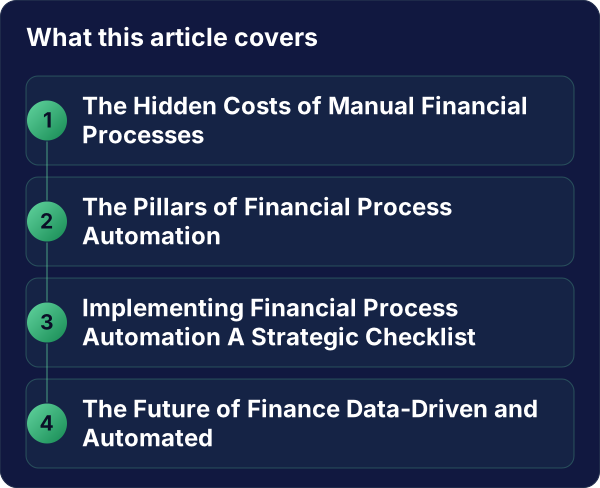
The Pillars of Financial Process Automation
Financial process automation is not a single solution but a suite of technologies and strategies designed to automate various financial workflows. Key areas of focus include:
Accounts Payable (AP) Automation
AP automation tackles the entire invoice-to-pay cycle. This involves capturing invoices, extracting data, routing them for approval, processing payments, and reconciling transactions.
- Key Features:
- Intelligent Document Processing (IDP): Utilizes OCR (Optical Character Recognition) and AI to extract relevant data from invoices, regardless of format.
- Automated Workflow Routing: Directs invoices to the correct approvers based on predefined rules (e.g., department, amount, vendor).
- Electronic Payments: Facilitates direct deposit, ACH, or virtual card payments, reducing manual check processing.
- Automated Reconciliation: Matches invoices with purchase orders and receipts, flagging discrepancies for review.
- Benefits:
- Reduced Processing Time: Invoices are processed significantly faster, often within hours instead of days.
- Error Reduction: Eliminates manual data entry errors, improving accuracy.
- Early Payment Discounts: Enables businesses to capture early payment discounts, improving cash flow and profitability.
- Improved Vendor Relationships: Timely and accurate payments lead to better vendor relations.
- KPI Impact: Reduced AP Processing Cost Per Invoice, increased Early Payment Discount Capture Rate, and improved Vendor On-Time Payment Percentage.
Accounts Receivable (AR) Automation
AR automation streamlines the entire order-to-cash process, from invoicing to cash application. This ensures faster collection of payments and improves cash flow.
- Key Features:
- Automated Invoice Generation and Delivery: Creates and sends invoices automatically based on sales orders or service delivery.
- Payment Reminders and Dunning: Automates follow-up communications for overdue invoices.
- Automated Cash Application: Matches incoming payments with outstanding invoices, often using AI to interpret remittance advices.
- Customer Portal: Provides customers with self-service options for viewing invoices, making payments, and accessing their account history.
- Benefits:
- Faster Cash Collection: Reduces DSO by expediting invoicing and payment processes.
- Improved Cash Flow: Predictable and consistent cash inflow.
- Reduced Bad Debt: Proactive dunning and collection efforts minimize write-offs.
- Enhanced Customer Experience: Self-service options and clear communication improve customer satisfaction.
- KPI Impact: Reduced Days Sales Outstanding (DSO), increased Cash Conversion Cycle (CCC) efficiency, and lower Bad Debt Percentage.
Expense Management Automation
Automating expense reporting and reimbursement processes frees employees from tedious manual tasks and provides better visibility into spending.
- Key Features:
- Mobile Expense Capture: Employees can snap photos of receipts and submit expenses via mobile apps.
- Automated Policy Compliance: Rules-based engines ensure expenses adhere to company policies.
- Automated Approval Workflows: Routes expense reports for timely approval.
- Direct Reimbursement: Integrates with payroll or payment systems for faster reimbursements.
- Benefits:
- Employee Productivity: Saves employees time and reduces frustration.
- Cost Control: Ensures adherence to budgets and policies.
- Faster Reimbursements: Improves employee morale.
- Real-time Visibility: Provides insights into spending patterns.
- KPI Impact: Reduced Expense Report Processing Time, increased Employee Satisfaction with Reimbursement Process, and improved Budget Variance.
Financial Close Automation
The financial close process is often the most complex and time-consuming period for finance teams. Automation can significantly accelerate this critical cycle.
- Key Features:
- Automated Journal Entries: Prepares and posts recurring and standard journal entries.
- Automated Reconciliations: Streamlines the reconciliation of balance sheet accounts.
- Automated Intercompany Accounting: Manages and reconciles transactions between different entities within a group.
- Standardized Reporting Packages: Generates consistent and accurate financial statements and management reports.
- Benefits:
- Faster Close Cycles: Reduces the time to close the books from weeks to days, or even hours.
- Improved Accuracy: Minimizes errors associated with manual data manipulation.
- Enhanced Compliance: Ensures adherence to accounting standards and regulations.
- Increased Strategic Focus: Frees up finance teams to perform higher-value analysis.
- KPI Impact: Reduced Days to Close Financial Statements, improved Accuracy of Financial Reporting, and higher Finance Team Capacity for Strategic Analysis.
Implementing Financial Process Automation: A Strategic Checklist
Adopting financial process automation requires a strategic approach. Here’s a checklist to guide your implementation:
1. Assess Current Processes and Identify Bottlenecks
- Action: Map out your existing financial workflows, from invoice receipt to financial reporting.
- Focus: Identify manual touchpoints, areas prone to errors, and processes that cause delays. Quantify the time and resources spent on these tasks.
- Tools: Process mapping software, time tracking, stakeholder interviews.
2. Define Clear Objectives and KPIs
- Action: Determine what you want to achieve with automation.
- Focus: Set specific, measurable, achievable, relevant, and time-bound (SMART) goals. Examples: Reduce DSO by 15% within six months, decrease AP processing costs by 20% in the next fiscal year.
- Tools: Business case development, KPI dashboards.
3. Select the Right Technology Stack
- Action: Research and evaluate automation solutions that align with your objectives and existing systems.
- Focus: Consider scalability, integration capabilities (with ERP, CRM, etc.), user-friendliness, security, and vendor support.
- Tools: Software comparison matrices, vendor demos, proof-of-concept projects.
4. Prioritize and Pilot
- Action: Start with a pilot program for a specific process or department.
- Focus: Choose a process with high potential for improvement and relatively low complexity to ensure early success and build momentum.
- Tools: Project management methodologies, phased rollout plans.
5. Data Preparation and Cleansing
- Action: Ensure your financial data is accurate, consistent, and well-structured.
- Focus: Cleanse duplicate entries, standardize formats, and validate data integrity before migrating to automated systems.
- Tools: Data cleansing tools, data governance policies.
6. Integration with Existing Systems
- Action: Seamlessly integrate automation tools with your ERP, accounting software, and other relevant systems.
- Focus: APIs and middleware solutions are crucial for data flow and avoiding silos.
- Tools: Integration platforms, API documentation.
7. Training and Change Management
- Action: Provide comprehensive training to your finance team and relevant stakeholders.
- Focus: Address user adoption challenges, communicate the benefits of automation, and foster a culture of continuous improvement.
- Tools: Training materials, workshops, internal communication campaigns.
8. Monitor, Measure, and Optimize
- Action: Continuously track your defined KPIs and gather feedback.
- Focus: Use performance data to identify areas for further optimization and refinement of your automated processes.
- Tools: Analytics dashboards, regular performance reviews.
The Future of Finance: Data-Driven and Automated
The trend towards financial process automation is not just a temporary shift; it’s the evolution of the finance function. As technology advances, the capabilities of automation will only expand, enabling even more sophisticated financial operations. For B2B agencies and startups, embracing this evolution is critical for staying competitive.
By automating repetitive, low-value tasks, your finance teams can transition from transactional processing to strategic partnership. They can become proactive advisors, leveraging real-time data and advanced analytics to drive business growth, identify new opportunities, and mitigate risks effectively. This shift empowers your organization to be more agile, responsive, and ultimately, more successful.
The adoption of financial process automation is a strategic imperative for any forward-thinking B2B technology company. It’s about more than just efficiency; it’s about building a resilient, scalable, and intelligent financial infrastructure that supports your long-term vision.
At Alken, we specialize in empowering B2B agencies and startups with cutting-edge software solutions. We understand the unique challenges faced by product leaders, CTOs, and technology teams in optimizing their internal operations. Our expertise in financial process automation can help you eliminate errors, accelerate your closing cycles, and free up your team to focus on what truly matters: innovation and growth.
Ready to transform your financial operations and gain a competitive edge?
Contact us today at info@alken.dev to discuss how Alken can tailor a financial process automation strategy for your business.