AI customer support automation: limits, risks, and opportunities
Explore AI customer support automation: its limits, risks, and opportunities for B2B agencies and startups. Drive efficiency and quality.
In today’s fast-paced digital landscape, delivering exceptional customer support is no longer a differentiator; it’s a baseline expectation. For B2B agencies and startups, scaling support operations while maintaining high quality and controlling costs presents a significant challenge. This is where AI customer support automation, or “IA automatización soporte cliente” as it’s known in some markets, emerges as a powerful solution. However, like any transformative technology, it comes with its own set of limitations, inherent risks, and vast opportunities.
This article delves into the nuanced reality of AI-powered customer support, offering product leaders, CTOs, and technology teams actionable insights to navigate its complexities and harness its full potential. We’ll explore how to balance efficiency gains with the crucial element of perceived quality, ensuring your customer interactions are not just faster, but also more effective and satisfying.
The Promise of AI in Customer Support
The allure of AI customer support automation is undeniable. The core promise revolves around enhancing efficiency, reducing operational costs, and improving response times. By automating repetitive tasks and providing instant answers to common queries, AI can significantly alleviate the burden on human support agents, allowing them to focus on more complex and high-value interactions.
Key Benefits and Metrics
- 24/7 Availability: AI-powered chatbots and virtual assistants can provide round-the-clock support, ensuring customers receive assistance whenever they need it, regardless of time zones or business hours. This directly impacts customer satisfaction scores (CSAT) and Net Promoter Scores (NPS) by reducing wait times.
- Reduced Response Times: AI can instantly process and respond to a high volume of inquiries. This can lead to a dramatic reduction in Average Handling Time (AHT) for common issues, freeing up human agents for more intricate problems.
- Cost Efficiency: Automating a significant portion of support interactions can lead to substantial cost savings by reducing the need for a large human support team, especially for Tier 1 queries. This can be measured by Cost Per Ticket or Customer Support Operational Expenditure.
- Scalability: As your business grows, AI can scale seamlessly to handle increasing customer volumes without a proportional increase in headcount. This is crucial for agile startups and growing agencies.
- Data-Driven Insights: AI systems can collect and analyze vast amounts of customer interaction data, providing valuable insights into common pain points, product issues, and customer sentiment. This data can inform product development and service improvements, impacting Customer Lifetime Value (CLV) and churn rate.
Real-World Applications
- Chatbots for FAQs: Deploying chatbots on websites and within applications to answer frequently asked questions, guide users through basic troubleshooting, and direct them to relevant resources.
- Automated Ticket Routing: AI can analyze incoming support tickets and automatically categorize and route them to the most appropriate agent or department, speeding up resolution times.
- Sentiment Analysis: AI can analyze customer communications (emails, chat logs) to gauge sentiment, flagging urgent or negative interactions for immediate human attention.
- Proactive Support: AI can identify potential issues before they impact customers, such as predicting service disruptions or identifying users struggling with a particular feature, and proactively offer assistance.
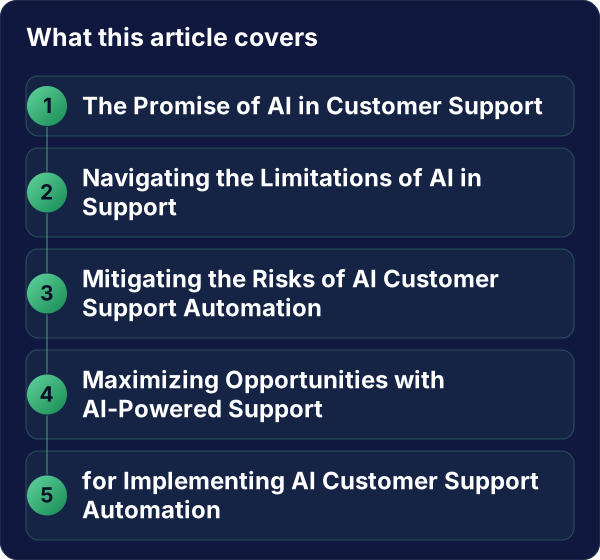
Navigating the Limitations of AI in Support
While the benefits are compelling, it’s crucial to acknowledge that AI customer support automation is not a panacea. Understanding its limitations is key to setting realistic expectations and designing effective implementation strategies.
The Nuances of Human Interaction
- Empathy and Emotional Intelligence: AI, in its current form, struggles to replicate genuine empathy, emotional understanding, and the nuanced communication that human agents excel at. Complex emotional situations, frustrated customers, or highly sensitive issues often require a human touch.
- Handling Novel or Complex Issues: AI is trained on existing data. When faced with entirely new, complex, or edge-case problems that fall outside its training parameters, AI can falter, leading to frustrating customer experiences.
- Understanding Context and Subtlety: Human language is rich with subtlety, sarcasm, and implied meaning. AI can sometimes misinterpret these nuances, leading to inaccurate responses or a failure to grasp the true intent behind a customer’s query.
- Brand Voice and Personality: While AI can be programmed to adopt a certain tone, it can be challenging to consistently imbue it with a unique brand voice and personality that resonates deeply with customers.
Technical and Data Dependencies
- Data Quality and Bias: The effectiveness of AI is heavily dependent on the quality and quantity of the data it’s trained on. Biased or incomplete data can lead to discriminatory or inaccurate outputs, impacting fairness and customer trust.
- Integration Complexity: Integrating AI solutions with existing CRM, ticketing systems, and knowledge bases can be technically challenging and require significant development resources.
- Maintenance and Updates: AI models require ongoing maintenance, retraining, and updates to remain effective and adapt to evolving customer needs and product changes.
Mitigating the Risks of AI Customer Support Automation
Implementing AI without careful consideration can introduce significant risks that can damage customer relationships and brand reputation. Proactive risk mitigation is paramount.
Potential Pitfalls and How to Avoid Them
- The “Frustration Loop”: Customers getting stuck in an endless loop with a chatbot that cannot understand their query or provide a satisfactory solution.
- Mitigation: Implement clear escalation paths to human agents. Design AI to recognize when it’s failing and offer a seamless handover. Monitor chatbot performance for common failure points.
- Data Privacy and Security Breaches: AI systems often handle sensitive customer data. A breach can have severe legal and reputational consequences.
- Mitigation: Prioritize robust security protocols, encryption, and compliance with data privacy regulations (e.g., GDPR, CCPA). Conduct regular security audits.
- Over-reliance and Deskilling: Excessive reliance on AI can lead to a deskilling of human support agents, making them less capable of handling complex issues when AI fails.
- Mitigation: Position AI as a tool to augment, not replace, human agents. Invest in continuous training for your human team, focusing on problem-solving, empathy, and handling escalated cases.
- Brand Damage from Poor AI Performance: Inaccurate, irrelevant, or impersonal AI responses can lead to negative reviews and a damaged brand image.
- Mitigation: Rigorous testing and quality assurance are essential before deployment. Continuously monitor AI performance and gather customer feedback.
- Ethical Concerns and Bias: AI algorithms can inadvertently perpetuate societal biases present in training data, leading to unfair treatment of certain customer segments.
- Mitigation: Actively audit AI models for bias. Ensure diverse datasets are used for training. Implement fairness metrics and ethical guidelines for AI development and deployment.
Maximizing Opportunities with AI-Powered Support
Despite the limitations and risks, the opportunities presented by AI customer support automation are immense for B2B agencies and startups looking to gain a competitive edge. The key lies in a strategic, human-centric approach.
Strategic Implementation for Growth
- Hybrid Support Models: The most effective approach is often a hybrid model where AI handles routine tasks, and human agents manage complex, emotional, or high-value interactions. This optimizes both efficiency and customer experience.
- Personalization at Scale: AI can analyze customer data to deliver personalized support experiences, recommending relevant solutions, products, or content based on individual needs and history. This can significantly boost engagement and conversion rates.
- Predictive Support: Leverage AI to anticipate customer needs and potential issues. For instance, if a customer is repeatedly visiting a help page for a specific feature, AI can trigger a proactive outreach from a support agent or offer an in-app guide.
- Empowering Human Agents: AI can act as a co-pilot for human agents, providing them with real-time information, suggested responses, and relevant customer history, enabling them to resolve issues faster and more effectively. This boosts agent productivity and job satisfaction, impacting employee retention.
- Continuous Improvement Loop: Use AI-generated data to continuously refine your support processes, product offerings, and knowledge base. This creates a virtuous cycle of improvement.
Measuring Success: Key Performance Indicators (KPIs)
To truly gauge the impact of AI customer support automation, focus on a balanced set of KPIs:
- Customer Satisfaction (CSAT): Track overall customer happiness with support interactions.
- Net Promoter Score (NPS): Measure customer loyalty and their likelihood to recommend your service.
- First Contact Resolution (FCR): The percentage of issues resolved on the first interaction, whether by AI or a human.
- Average Handling Time (AHT): The average time it takes to resolve a customer issue.
- Cost Per Ticket: The total cost of support divided by the number of tickets handled.
- Agent Productivity: Measure how much more efficient human agents become with AI assistance.
- Escalation Rate: The percentage of AI interactions that require human intervention. A lower rate for routine issues indicates AI effectiveness.
Checklist for Implementing AI Customer Support Automation
Before embarking on your AI customer support automation journey, consider this checklist to ensure a strategic and successful deployment:
Planning and Preparation
- Define Clear Objectives: What specific problems are you trying to solve? (e.g., reduce AHT, improve CSAT, lower costs).
- Identify Use Cases: Where will AI provide the most immediate and impactful value? (e.g., FAQs, basic troubleshooting, lead qualification).
- Assess Data Readiness: Is your customer data clean, organized, and sufficient for training AI models?
- Evaluate Existing Infrastructure: How will AI integrate with your current CRM, helpdesk, and knowledge base?
- Budget Allocation: Determine the investment required for technology, implementation, and ongoing maintenance.
Technology and Implementation
- Choose the Right AI Solution: Select a platform that aligns with your technical capabilities and business needs.
- Prioritize Security and Compliance: Ensure the chosen solution meets your data security and privacy standards.
- Develop a Phased Rollout Strategy: Start with a pilot program to test and refine before a full-scale launch.
- Design Clear Escalation Paths: Ensure seamless handoffs from AI to human agents.
- Train Your AI Models: Invest time and resources in robust training and continuous learning.
Human Element and Ongoing Management
- Train Your Support Team: Equip your human agents with the skills to work alongside AI and handle escalated issues.
- Establish Feedback Mechanisms: Collect customer and agent feedback on AI performance.
- Monitor Performance Regularly: Track key KPIs and identify areas for improvement.
- Plan for Iteration and Updates: AI is not a set-it-and-forget-it solution; it requires ongoing refinement.
- Maintain Brand Voice Consistency: Ensure AI interactions align with your brand’s tone and personality.
Conclusion: The Future of Support is Intelligent and Human
AI customer support automation offers a transformative path for B2B agencies and startups to achieve unprecedented levels of efficiency, scalability, and data-driven insights. However, its true power is unlocked not by replacing human interaction, but by augmenting it. By understanding the limitations, proactively mitigating risks, and strategically embracing the opportunities, you can build a customer support function that is both remarkably efficient and deeply human.
The future of customer support lies in this intelligent synergy – where AI handles the predictable and repetitive, freeing up your invaluable human talent to focus on building relationships, solving complex problems, and delivering moments of genuine delight. This is how you not only meet but exceed customer expectations in an increasingly competitive market.
At Alken, we specialize in helping B2B agencies and startups harness the power of AI to revolutionize their customer support operations. We understand the delicate balance between automation and the human touch, and we are dedicated to crafting solutions that drive both efficiency and unparalleled customer satisfaction.
Ready to explore how AI can elevate your customer support?
Contact us today at info@alken.dev to discuss your specific needs and discover the Alken advantage.