Automated frontend QA: testing strategy for agile teams
Master automated frontend QA for agile teams. Discover strategies, tools, and KPIs to accelerate your product releases and improve quality.

In today’s fast-paced digital landscape, delivering high-quality software at speed is no longer a competitive advantage – it’s a necessity. For product leaders, CTOs, and technology teams navigating the complexities of agile development, ensuring the reliability and user experience of your frontend applications is paramount. This is where automated frontend QA steps in, transforming traditional testing bottlenecks into powerful accelerators.
Traditional manual testing, while valuable for exploratory testing and usability, simply cannot keep pace with the rapid iteration cycles of agile methodologies. The sheer volume of changes, coupled with the increasing complexity of modern web applications, makes manual regression testing an unsustainable and error-prone endeavor. Embracing automated frontend QA is not just about efficiency; it’s about building robust, scalable, and user-centric products that stand out in a crowded market.
This comprehensive guide will equip you with the knowledge to implement a strategic approach to automated frontend QA, focusing on the right balance of unit, integration, and end-to-end (E2E) tests. We’ll delve into best practices, key metrics, and how to leverage automation to drive continuous improvement and faster time-to-market.
The Pillars of Effective Automated Frontend QA
A robust qa automatizado frontend strategy is built on a foundation of well-defined testing levels. Each level serves a distinct purpose, contributing to a comprehensive safety net that catches bugs early and ensures overall application integrity. The key is to achieve a strategic balance, investing in the right types of tests at the right stages of development.
1. Unit Testing: The Granular Foundation
Unit tests are the smallest, most isolated tests in your qa automatizado frontend suite. They focus on verifying the smallest pieces of code – individual functions, methods, or components – in isolation from the rest of the application.
- Purpose: To ensure that individual units of code behave as expected. They are excellent for catching logic errors and validating the correctness of specific algorithms.
- Benefits:
- Early Bug Detection: Identifies issues at the most granular level, making them cheaper and easier to fix.
- Improved Code Design: Encourages developers to write modular, testable code.
- Fast Execution: Unit tests are typically very fast, providing quick feedback to developers.
- Living Documentation: Well-written unit tests can serve as documentation for how specific code units are intended to be used.
- Key Metrics:
- Code Coverage: Percentage of code executed by unit tests. Aim for high coverage, but focus on critical logic.
- Test Pass Rate: Percentage of unit tests that pass successfully.
- Tools: Jest, Mocha, Chai (for JavaScript/TypeScript); JUnit (for Java); NUnit (.NET).
2. Integration Testing: Connecting the Dots
Integration tests focus on verifying the interactions between different units or modules of your application. They ensure that these components work together harmoniously.
- Purpose: To validate that integrated components function correctly as a group. This is crucial for testing how different parts of your frontend, or frontend and backend APIs, communicate.
- Benefits:
- Detects Interface Defects: Catches issues arising from incorrect assumptions about how modules interact.
- Validates Data Flow: Ensures data is passed and processed correctly between components.
- Builds Confidence in System Parts: Provides assurance that connected modules are working as intended.
- Key Metrics:
- Integration Test Pass Rate: Percentage of integration tests that pass.
- Defect Escape Rate (from integration to E2E): Lower is better.
- Tools: Testing Library (React, Vue, Angular), SuperTest (for API integrations), Cypress (can also be used for integration).
3. End-to-End (E2E) Testing: Simulating Real User Journeys
E2E tests simulate real user scenarios from start to finish, interacting with the application as a user would through the UI. These are the most comprehensive tests in your qa automatizado frontend strategy.
- Purpose: To validate the entire application flow from the user’s perspective, ensuring that all integrated components work together to deliver the expected user experience.
- Benefits:
- User-Centric Validation: Confirms that the application meets user needs and business requirements.
- Detects System-Wide Issues: Catches bugs that might be missed by unit or integration tests, especially those related to complex workflows or external dependencies.
- High Confidence in Production Readiness: Provides the highest level of assurance that the application will function correctly in a production environment.
- Key Metrics:
- E2E Test Pass Rate: Percentage of E2E tests that pass.
- Test Execution Time: E2E tests are typically slower, so monitoring execution time is important for pipeline efficiency.
- Defect Escape Rate (to production): The ultimate measure of E2E effectiveness.
- Tools: Cypress, Playwright, Selenium WebDriver.
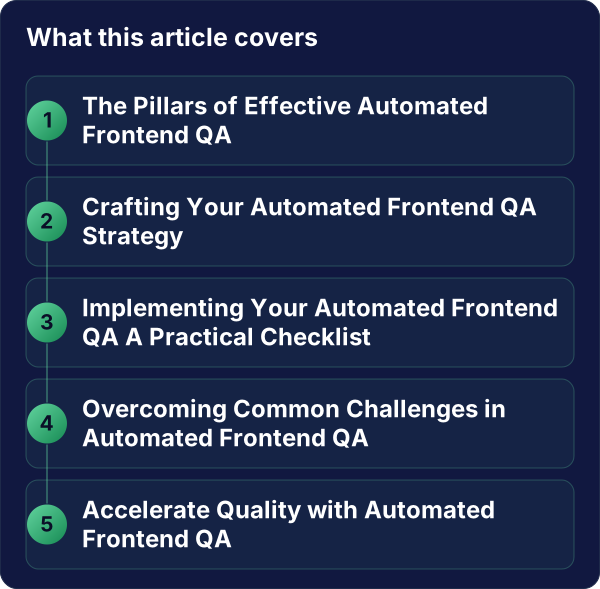
Crafting Your Automated Frontend QA Strategy
A successful qa automatizado frontend strategy isn’t just about choosing the right tools; it’s about a well-defined process and a culture of quality. Agile teams need a strategy that integrates seamlessly into their development lifecycle.
1. Define Clear Testing Objectives and Scope
Before diving into automation, clearly define what you want to achieve. What are the critical user journeys? What are the most important features to test?
- Identify Critical User Flows: Map out the most common and crucial paths users take through your application (e.g., registration, login, checkout, search). These should be prioritized for E2E testing.
- Determine Risk Areas: Identify components or features that are prone to bugs or have a high impact on user experience. These areas warrant more comprehensive testing at all levels.
- Establish Baselines: Understand your current defect escape rate and time-to-market to measure the impact of your automation efforts.
2. Implement the Test Pyramid (or Honeycomb)
The traditional “test pyramid” advocates for a large base of fast unit tests, a moderate layer of integration tests, and a small, focused layer of slow E2E tests. While still relevant, some modern approaches favor a “test honeycomb” which acknowledges the increasing importance and reliability of certain E2E tests and API-level tests.
- Test Pyramid Rationale:
- Unit Tests (Base): Many, fast, cheap to write and run. Catch bugs early.
- Integration Tests (Middle): Fewer than unit tests, moderate speed and cost. Verify component interactions.
- E2E Tests (Top): Fewest, slowest, most expensive. Validate complete user flows.
- Test Honeycomb Adaptation: The honeycomb model suggests a more balanced approach, potentially with more robust E2E tests if your architecture and tooling allow for stable and fast execution. It also emphasizes the importance of contract testing and API-level tests as a strong middle layer.
- Finding Your Balance: The ideal structure depends on your application’s complexity, team expertise, and risk tolerance. For most agile teams, a strong emphasis on unit and integration tests, supplemented by well-maintained E2E tests for critical paths, is a winning formula.
3. Integrate Automation into the CI/CD Pipeline
Continuous Integration and Continuous Delivery (CI/CD) are fundamental to agile development. Your qa automatizado frontend suite must be an integral part of this pipeline.
- Automated Builds and Tests: Trigger automated tests on every code commit or pull request. This provides immediate feedback to developers.
- Staged Deployments: Use test results to gate deployments to different environments (e.g., staging, production).
- Fast Feedback Loops: Aim for test suites that run within minutes to avoid blocking development progress. If E2E tests are too slow, consider optimizing them or running them less frequently in the pipeline (e.g., nightly builds).
- Key KPIs:
- Build Success Rate: Percentage of successful builds in the CI/CD pipeline.
- Test Execution Time in Pipeline: Average time for your automated test suite to run.
- Mean Time to Detect (MTTD): How quickly bugs are identified after introduction.
4. Prioritize Maintainability and Scalability
Automated tests are code, and like any code, they require maintenance. A poorly maintained test suite can become a burden rather than an asset.
- Write Readable and Maintainable Tests: Follow coding best practices, use clear naming conventions, and keep tests focused.
- Page Object Model (POM) or App Actions: For E2E tests, use design patterns like POM to abstract UI elements and interactions, making tests easier to update when the UI changes.
- Data Management: Implement strategies for managing test data to ensure tests are repeatable and not dependent on specific pre-existing data.
- Scalable Infrastructure: Ensure your test execution infrastructure can scale with your application’s growth and test suite size.
Implementing Your Automated Frontend QA: A Practical Checklist
To put these strategies into action, follow this practical checklist for building and maintaining your qa automatizado frontend capabilities.
Getting Started:
- Assess Current Testing Practices: Identify gaps, manual effort, and recurring issues.
- Define Scope and Prioritize: Map critical user journeys and high-risk areas.
- Choose the Right Tools: Select frameworks and libraries that align with your tech stack and team expertise.
- Establish a Testing Environment: Set up dedicated environments for running automated tests.
- Integrate with Version Control: Store test code in your repository alongside application code.
Development and Maintenance:
- Write Unit Tests for All New Code: Encourage developers to write unit tests as part of their coding process.
- Develop Integration Tests for Key Interactions: Focus on how components and services communicate.
- Build E2E Tests for Critical User Flows: Prioritize these for the most impactful user journeys.
- Implement the Test Pyramid/Honeycomb Principle: Ensure a healthy balance across test levels.
- Adopt Design Patterns: Use POM or similar patterns for E2E test maintainability.
- Manage Test Data Effectively: Create robust strategies for data setup and teardown.
- Regularly Review and Refactor Tests: Treat test code with the same rigor as production code.
- Automate Test Execution in CI/CD: Trigger tests on every relevant code change.
- Monitor Test Results and Performance: Track pass rates, execution times, and identify flaky tests.
- Invest in Developer Training: Ensure your team has the skills to write and maintain effective automated tests.
Continuous Improvement:
- Analyze Defect Trends: Use test results to identify recurring problem areas in the codebase.
- Measure Impact on Release Cycles: Track how automation affects your time-to-market and release frequency.
- Gather Feedback from Stakeholders: Understand how the quality of releases is perceived.
- Adapt Your Strategy: Continuously refine your qa automatizado frontend approach based on learnings and evolving needs.
Overcoming Common Challenges in Automated Frontend QA
Even with a well-defined strategy, teams often encounter hurdles. Proactive planning can help mitigate these.
1. Flaky Tests
Flaky tests are tests that sometimes pass and sometimes fail without any changes to the code being tested. They are a major productivity killer.
- Causes: Timing issues, race conditions, unstable test environments, reliance on external services, poor test data management.
- Solutions:
- Robust Waits: Implement intelligent waits instead of fixed timeouts.
- Test Isolation: Ensure tests don’t depend on the state left by previous tests.
- Stable Test Data: Use reliable data setup and teardown mechanisms.
- Dedicated Test Environments: Minimize interference from other processes.
- Retry Mechanisms (with caution): Implement retries for known intermittent issues, but investigate the root cause.
2. Slow Test Execution Times
Long test run times can significantly slow down development feedback loops and CI/CD pipelines.
- Causes: Over-reliance on E2E tests, inefficient test code, slow test infrastructure, large test suites.
- Solutions:
- Optimize E2E Tests: Focus E2E tests on critical paths and ensure they are efficient.
- Parallel Execution: Run tests in parallel across multiple machines or containers.
- Test Sharding: Divide the test suite into smaller, manageable chunks that can be run in parallel.
- Selective Test Runs: Configure your pipeline to run only relevant tests based on code changes.
- Invest in Faster Hardware/Cloud Resources: Scale your test infrastructure.
3. Test Maintenance Overhead
As applications evolve, test suites can become difficult and time-consuming to maintain.
- Causes: Poorly structured tests, lack of design patterns, frequent UI changes without corresponding test updates, insufficient test coverage.
- Solutions:
- Adopt Design Patterns (POM, etc.): Centralize UI interactions for easier updates.
- Modular Test Design: Break down complex tests into smaller, reusable components.
- Code Reviews for Tests: Treat test code with the same scrutiny as production code.
- Automated UI Change Detection (advanced): Tools can sometimes help identify UI elements that have changed.
- Regular Refactoring: Schedule time to clean up and optimize the test suite.
Conclusion: Accelerate Quality with Automated Frontend QA
Embracing qa automatizado frontend is a strategic imperative for agile teams striving for excellence. By strategically balancing unit, integration, and E2E tests, integrating automation into your CI/CD pipeline, and prioritizing maintainability, you can significantly improve your product quality, reduce time-to-market, and gain a competitive edge.
The journey to mature automated frontend QA is ongoing. It requires a commitment to continuous learning, adaptation, and a culture that values quality at every stage of development. At Alken, we understand the challenges and opportunities that come with building robust, scalable frontend applications. Our expertise in qa automatizado frontend can help your team navigate this landscape, implement effective testing strategies, and accelerate your path to delivering exceptional user experiences.
Ready to transform your testing process and accelerate your product releases? Let’s build a more reliable and efficient future for your frontend development.
Contact us today at info@alken.dev to learn how Alken can empower your agile team with best-in-class automated frontend QA solutions.