Third-party integration strategy for SaaS: what to build and what not
Master your SaaS third-party integration strategy. Learn what to build, what to buy, and how to drive growth with expert insights.
In today’s hyper-connected digital landscape, the success of a SaaS product is no longer solely determined by its core functionality. The ability to seamlessly integrate with other essential tools and platforms is paramount. For product leaders, CTOs, and technology teams, developing a robust third-party integration strategy is not just a technical consideration; it’s a strategic imperative that directly impacts customer acquisition, retention, and overall market competitiveness. This article will guide you through the intricacies of building an effective third-party integration strategy for your SaaS, focusing on what to prioritize building in-house versus what to leverage from external solutions.
The Strategic Imperative of SaaS Integrations
The modern SaaS ecosystem is a complex web of interconnected applications. Customers expect their chosen software to play nicely with their existing tech stack, whether it’s a CRM, marketing automation platform, accounting software, or a niche industry-specific tool. Failing to offer these integrations can lead to significant friction in the customer journey, increasing churn and limiting your addressable market.
A well-defined SaaS third-party integration strategy (translated from “estrategia integración terceros saas”) is crucial for several reasons:
- Enhanced Customer Value: Integrations extend the functionality of your core product, making it more indispensable to your users.
- Increased Stickiness and Reduced Churn: When your SaaS is deeply embedded in a customer’s workflow, they are less likely to switch to a competitor. This directly impacts your Customer Lifetime Value (CLTV).
- Faster Time-to-Market for New Features: By leveraging existing integrations, you can offer expanded capabilities without reinventing the wheel.
- Competitive Differentiation: A rich integration ecosystem can be a powerful differentiator in a crowded market.
- New Revenue Streams: Some integrations can be monetized directly or indirectly through partnerships.
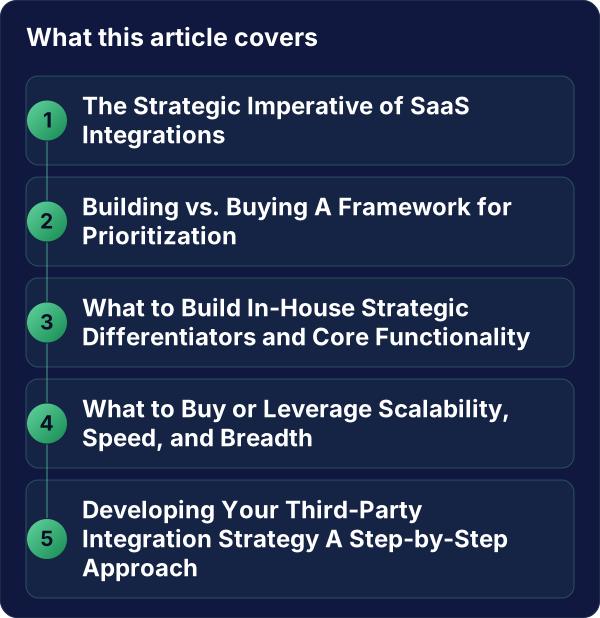
Building vs. Buying: A Framework for Prioritization
The central question in any integration strategy is: “Should we build this integration ourselves, or should we use a third-party solution?” This decision requires a careful evaluation of resources, strategic importance, and potential ROI. A common framework for prioritization is the Impact vs. Effort matrix, often visualized with Impact on one axis and Effort (or complexity/cost) on the other.
H2: Identifying High-Impact Integration Opportunities
Before diving into the build vs. buy decision, it’s essential to identify which integrations will have the most significant impact on your business goals. This involves understanding your target customer’s pain points and their existing technology stacks.
H3: Customer Research and Market Analysis
- Direct Customer Feedback: Regularly survey your existing customers and prospects about the tools they use and the integrations they desire. This is invaluable for understanding real-world needs.
- Sales and Support Insights: Your sales and customer success teams are on the front lines. They can provide critical intelligence on integration gaps that are preventing deals or causing customer dissatisfaction.
- Competitor Analysis: Examine your competitors’ integration marketplaces. What are they offering? Where are they succeeding? This can highlight both opportunities and threats.
- Market Trends: Stay abreast of emerging technologies and platforms that are gaining traction within your target industries.
H3: Defining Your Integration Pillars
Categorize potential integrations based on their strategic alignment with your core product vision.
- Essential Workflow Integrations: These are integrations that directly support the primary use cases of your SaaS. For example, a project management tool integrating with a time-tracking app.
- Data Enrichment Integrations: These integrations bring in external data to enhance your product’s insights or capabilities. Think of a marketing platform integrating with a data enrichment service.
- Ecosystem Integrations: These connect your SaaS to broader platforms or marketplaces, expanding your reach and user base.
What to Build In-House: Strategic Differentiators and Core Functionality
There are certain types of integrations that, if built in-house, can serve as significant competitive advantages and reinforce your product’s unique value proposition.
H2: Core Workflow Integrations That Define Your Product
If an integration is fundamental to your product’s core value proposition and directly enables its primary use cases, building it in-house is often the right choice. This allows for deeper control, tighter user experience, and a more seamless flow.
- Example: A CRM designed for real estate agents might build a deep, custom integration with a property listing database (MLS) directly into its core functionality. This isn’t just an add-on; it’s what makes the CRM uniquely valuable for its target audience.
- KPIs to Track:
- Feature Adoption Rate: Percentage of users utilizing the integrated feature.
- Time Saved per User: Quantifiable efficiency gains for users.
- Customer Satisfaction Scores (CSAT) related to the integrated workflow.
H2: Proprietary Data and Workflow Integrations
Integrations that leverage your unique data assets or enable proprietary workflows can be powerful differentiators. Building these allows you to maintain control over sensitive data and ensure a unique user experience that competitors cannot easily replicate.
- Example: A SaaS platform that analyzes financial trading data might build its own real-time integration with stock exchanges, rather than relying on a generic data feed. This allows for specialized data processing and unique analytical capabilities.
- Considerations:
- Development Resources: Do you have the engineering talent and bandwidth?
- Maintenance Overhead: Ongoing support and updates are critical.
- Scalability: Can your in-house solution scale with user growth?
H2: Integrations Critical for Security and Compliance
For highly regulated industries or when dealing with sensitive data, building custom integrations can provide the necessary control over security protocols and compliance requirements.
- Example: A healthcare SaaS platform handling patient data might build its own secure integration with Electronic Health Records (EHR) systems to ensure HIPAA compliance, rather than relying on a third-party connector that might not meet stringent requirements.
- Key Metrics:
- Security Incident Rate: Number of breaches or vulnerabilities.
- Compliance Audit Pass Rate.
What to Buy or Leverage: Scalability, Speed, and Breadth
For many other integration needs, leveraging third-party solutions offers significant advantages in terms of speed, cost-effectiveness, and breadth of coverage.
H2: Broad Ecosystem Integrations for Wide Appeal
To reach a wider audience and cater to diverse customer needs, integrating with popular, widely-used platforms is essential. Building individual integrations for every popular tool can be an unsustainable drain on resources.
- Example: A marketing automation platform needs to integrate with a vast array of CRMs (Salesforce, HubSpot, Zoho), email marketing tools (Mailchimp, Constant Contact), and analytics platforms (Google Analytics, Adobe Analytics). Building all of these natively would be a monumental task.
- Leveraging Integration Platforms: Consider using Integration Platform as a Service (iPaaS) solutions like Zapier, Make (formerly Integromat), or Workato. These platforms offer pre-built connectors and robust workflow automation capabilities, allowing you to offer a wide range of integrations with less development effort.
- KPIs:
- Number of Active Integrations: Total integrations enabled by users.
- Integration Usage Rate: Percentage of users actively using specific integrations.
- Customer Acquisition Cost (CAC) reduction due to integration availability.
H2: Niche or Less Frequently Used Integrations
If an integration serves a smaller segment of your user base or is for a niche tool that doesn’t align with your core strategic focus, it’s often more efficient to leverage third-party solutions or an iPaaS.
- Example: A general project management tool might offer a basic integration with a niche industry-specific accounting software through an iPaaS. This provides value to a subset of users without requiring dedicated internal development resources.
- Focus on API Availability: Ensure the target third-party tools have robust and well-documented APIs to facilitate easier integration, whether built in-house or via an iPaaS.
H2: Standardized and Commodity Integrations
Integrations that are widely available and don’t offer a unique competitive advantage are prime candidates for third-party solutions. These often include common functionalities like single sign-on (SSO) via OAuth or SAML, or basic data synchronization.
- Example: Implementing SSO with Google, Microsoft, or Okta. While critical for enterprise clients, building and maintaining these protocols from scratch is complex and resource-intensive. Leveraging established identity providers and their SDKs is the standard approach.
- Benefits:
- Reduced Development Time: Faster deployment of essential features.
- Lower Maintenance Costs: Rely on the third-party provider for updates and security.
- Access to Expertise: Benefit from the specialized knowledge of integration platform providers.
Developing Your Third-Party Integration Strategy: A Step-by-Step Approach
A structured approach is key to building a successful integration strategy.
H2: Checklist: Building Your SaaS Integration Strategy
- Define Strategic Goals: What do you want to achieve with integrations? (e.g., increase retention by X%, acquire Y new enterprise clients).
- Identify Target Integrations: Based on customer research, market analysis, and competitor insights, create a prioritized list of potential integrations.
- Assess Impact vs. Effort: For each potential integration, evaluate its potential business impact (revenue, retention, acquisition) against the effort required to build or integrate it (development time, cost, maintenance). Use a framework like the Impact/Effort matrix.
- Categorize: Build vs. Buy:
- Build: Integrations that are core to your product, offer strategic differentiation, or are critical for security/compliance.
- Buy/Leverage: Integrations that are common, serve broad ecosystems, or are for niche tools where dedicated development is not justified.
- Choose Your Integration Architecture:
- Direct API Integrations: For critical, deeply embedded integrations.
- Integration Platforms (iPaaS): For broad connectivity and automation.
- Webhooks: For real-time event notifications.
- Develop an Integration Roadmap: Plan the phased rollout of your integrations, prioritizing those with the highest impact and feasibility.
- Design for Scalability and Reliability: Ensure your integration infrastructure can handle increasing data volumes and user loads.
- Establish Monitoring and Support: Implement robust monitoring for integration health and have clear support processes in place.
- Iterate and Refine: Continuously gather feedback and analyze usage data to improve your integration offerings.
The Future of SaaS Integrations
The trend towards interconnectedness will only accelerate. As AI and machine learning become more prevalent, we can expect to see more intelligent and context-aware integrations that proactively offer solutions and insights. For SaaS companies, a forward-thinking integration strategy is not a luxury; it’s a fundamental requirement for sustained growth and market leadership.
By carefully considering what to build in-house for strategic advantage and what to leverage from third-party solutions for speed and breadth, you can create a powerful integration ecosystem that delights your customers and drives your business forward.
At Alken, we specialize in helping B2B SaaS companies navigate the complexities of integration strategy. Whether you need to define your roadmap, build custom integrations, or select the right iPaaS solutions, our expert team can provide the guidance and execution to accelerate your growth.
Ready to unlock the full potential of your SaaS product through strategic integrations?
Contact us today at info@alken.dev to discuss your integration needs.