B2B web application security: minimum controls for 2026
Enhance B2B web application security for 2026 with essential controls. Learn minimum requirements for product leaders & CTOs.
In today’s hyper-connected business landscape, the security of your B2B web applications isn’t just a technical concern; it’s a fundamental pillar of trust, reputation, and operational resilience. As we approach 2026, the threat landscape continues to evolve at an unprecedented pace, with sophisticated attacks targeting vulnerabilities in business-critical software. For product leaders, CTOs, and technology teams in English-speaking markets, understanding and implementing robust B2B web application security measures is no longer optional – it’s an imperative for survival and growth.
This article delves into the essential controls that every B2B software provider must prioritize to safeguard their applications, protect sensitive client data, and maintain a competitive edge. We’ll draw upon industry best practices, adapt them to a product-centric view, and provide actionable insights to help you fortify your digital assets.
The Evolving Threat Landscape for B2B Web Applications
The stakes for B2B web application security are higher than ever. Unlike B2C applications, B2B platforms often handle highly sensitive and proprietary data, including financial information, intellectual property, customer lists, and strategic plans. A breach in a B2B context can lead to:
- Severe Financial Losses: Beyond direct recovery costs, breaches can result in lost revenue, regulatory fines, and increased insurance premiums. For instance, the average cost of a data breach in 2023 was $4.45 million, according to IBM’s Cost of a Data Breach Report.
- Reputational Damage: Trust is the currency of B2B relationships. A security incident can erode client confidence, leading to churn and difficulty acquiring new business.
- Operational Disruption: Downtime caused by attacks can halt critical business processes for both your organization and your clients, impacting productivity and service delivery.
- Legal and Regulatory Penalties: Compliance with regulations like GDPR, CCPA, and industry-specific mandates is paramount. Non-compliance due to security failures can result in substantial fines.
The attack vectors are also becoming more sophisticated. We’re seeing a rise in supply chain attacks, advanced persistent threats (APTs), and exploitation of zero-day vulnerabilities. Therefore, a proactive and layered security strategy is crucial.
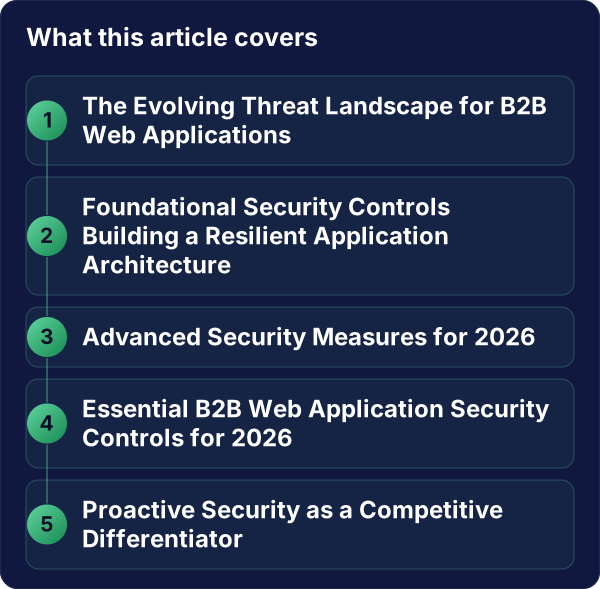
Foundational Security Controls: Building a Resilient Application Architecture
At the core of any secure B2B web application lies a solid foundation of well-implemented security controls. These are not afterthoughts but integral parts of the development lifecycle. We’ll adapt principles from the OWASP Application Security Verification Standard (ASVS) to a product management perspective, focusing on what product leaders need to ensure.
1. Secure Authentication and Session Management
Ensuring that only authorized users can access your application and that their sessions are protected is non-negotiable.
- Strong Password Policies: Enforce complexity requirements, disallow common passwords, and implement mechanisms for secure password resets. Consider passwordless authentication methods where appropriate.
- Multi-Factor Authentication (MFA): This is a baseline requirement for all B2B applications. MFA significantly reduces the risk of account compromise due to stolen credentials. Aim for at least two factors, such as something the user knows (password) and something the user has (token, mobile app authenticator).
- Secure Session Management:
- Session Token Generation: Use cryptographically secure random strings for session IDs.
- Session Timeout: Implement reasonable inactivity timeouts and absolute session expiration.
- Secure Transmission: Ensure session tokens are transmitted only over HTTPS.
- Session Hijacking Prevention: Implement techniques like session binding to IP addresses or user agents, though be mindful of user experience impacts.
Product Leader KPI: Track the percentage of active users enrolled in MFA. Aim for 95%+. Monitor session timeout effectiveness through user session data analysis.
2. Input Validation and Output Encoding
Preventing injection attacks, such as SQL injection and Cross-Site Scripting (XSS), is a continuous effort.
- Strict Input Validation: Never trust user input. Validate all data received from the client-side, API requests, and external sources against expected formats, types, and lengths. Use allow-lists where possible.
- Example: If expecting a numeric user ID, reject any input containing letters or special characters.
- Contextual Output Encoding: Encode data before rendering it in HTML, JavaScript, or other contexts to prevent malicious scripts from executing.
- Example: When displaying user-generated comments on a webpage, encode characters like
<and>to<and>respectively, preventing XSS.
- Example: When displaying user-generated comments on a webpage, encode characters like
- Parameterized Queries (for Databases): Always use parameterized queries or prepared statements for database interactions to prevent SQL injection.
Product Leader KPI: Monitor the number of identified injection vulnerabilities in penetration tests and code reviews. Aim for zero critical or high-severity findings. Track the adoption rate of secure coding practices within development teams.
3. Access Control and Authorization
Beyond authentication, robust authorization ensures users can only access the resources and perform actions they are permitted to.
- Principle of Least Privilege: Grant users only the minimum permissions necessary to perform their job functions.
- Role-Based Access Control (RBAC): Define clear roles with associated permissions. This simplifies management and reduces the likelihood of misconfigurations.
- Attribute-Based Access Control (ABAC): For more complex scenarios, ABAC can provide finer-grained control based on user attributes, resource attributes, and environmental conditions.
- Enforce Authorization at the API Level: Don’t rely solely on client-side controls. Every API endpoint must verify the caller’s authorization.
Product Leader KPI: Conduct regular access control audits. Measure the number of privilege escalation vulnerabilities found. Track the time taken to provision or de-provision user access.
Advanced Security Measures for 2026
As threats become more sophisticated, so too must your defenses. These advanced controls are crucial for maintaining a strong security posture.
4. Secure Data Handling and Encryption
Protecting data both in transit and at rest is paramount for B2B applications.
- Encryption in Transit: Use TLS 1.2 or higher for all network communications. This ensures that data exchanged between the client and server, or between microservices, is encrypted and protected from eavesdropping.
- Encryption at Rest: Encrypt sensitive data stored in databases, file systems, and backups. This includes customer PII, financial data, and any other confidential information.
- Key Management: Implement a secure and robust key management strategy for encryption keys.
- Data Minimization: Collect and store only the data that is absolutely necessary for the application’s functionality. The less data you hold, the less there is to protect.
Product Leader KPI: Verify that all data transmission uses current TLS versions. Track the percentage of sensitive data encrypted at rest. Measure the data retention period against compliance requirements.
5. Secure Development Lifecycle (SDLC) and Continuous Monitoring
Security must be baked into the development process from inception to deployment and beyond.
- Threat Modeling: Conduct threat modeling exercises early in the design phase to identify potential vulnerabilities and design countermeasures.
- Static Application Security Testing (SAST): Integrate SAST tools into your CI/CD pipeline to automatically scan code for common vulnerabilities.
- Dynamic Application Security Testing (DAST): Regularly perform DAST scans on running applications to identify runtime vulnerabilities.
- Software Composition Analysis (SCA): Use SCA tools to identify and manage vulnerabilities in third-party libraries and dependencies. A significant percentage of breaches exploit known vulnerabilities in open-source components.
- Security Training for Developers: Ensure your development teams are well-versed in secure coding practices and common attack vectors.
- Continuous Monitoring and Logging: Implement comprehensive logging of security-relevant events. Monitor these logs for suspicious activity, anomalies, and potential security incidents.
- Key Logs to Monitor: Authentication attempts (successes and failures), access control violations, input validation failures, error messages, and system configuration changes.
- Incident Response Plan: Have a well-defined and tested incident response plan in place to handle security breaches effectively and minimize damage.
Product Leader KPI: Measure the mean time to detect (MTTD) and mean time to respond (MTTR) to security incidents. Track the percentage of code committed that passes SAST scans without critical findings. Monitor the frequency of security training for development teams.
Checklist: Essential B2B Web Application Security Controls for 2026
To simplify the implementation of these critical controls, here’s a checklist designed for product leaders and CTOs:
Authentication & Session Management
- All user accounts require MFA.
- Strong password policies are enforced (complexity, history, length).
- Session tokens are generated securely and transmitted over HTTPS.
- Inactivity timeouts are configured and enforced.
Input Validation & Output Encoding
- All user-supplied input is validated against expected formats and types.
- Output encoding is applied contextually before rendering user-provided data.
- Parameterized queries or ORMs are used for all database interactions.
Access Control & Authorization
- Principle of Least Privilege is applied to all user roles.
- Role-Based Access Control (RBAC) is implemented.
- Authorization is enforced at the API level for all sensitive operations.
Data Handling & Encryption
- All external and internal communications use TLS 1.2 or higher.
- Sensitive data at rest (databases, files) is encrypted.
- A secure key management system is in place.
- Data minimization principles are followed.
Secure Development & Operations
- Threat modeling is performed during the design phase.
- SAST, DAST, and SCA tools are integrated into the CI/CD pipeline.
- Developers receive regular secure coding training.
- Comprehensive security logging is implemented and monitored.
- A tested incident response plan is in place.
- Regular penetration testing and vulnerability assessments are conducted.
Conclusion: Proactive Security as a Competitive Differentiator
In the competitive B2B software market, security is no longer a cost center but a significant differentiator. By prioritizing these minimum controls for 2026, you not only protect your clients and your business from devastating breaches but also build a reputation for reliability and trustworthiness. This proactive approach to seguridad aplicaciones web b2b (B2B web application security) fosters stronger client relationships, reduces operational risks, and ultimately drives sustainable growth.
At Alken, we understand the unique security challenges faced by B2B software providers. Our expertise in developing and securing complex web applications can help you implement these essential controls and build a resilient security posture.
Don’t wait for a breach to happen. Strengthen your B2B web application security today.
Contact us at info@alken.dev to discuss your security needs and how Alken can help you achieve robust, future-proof protection.