Legacy system modernization: phased plan to minimize risk
Unlock the potential of your business with a phased approach to legacy system modernization. Minimize risk and drive innovation.
In today’s hyper-competitive landscape, businesses are increasingly realizing that their aging, legacy systems are not just a drag on innovation, but a significant barrier to growth and agility. These monolithic, often complex, and difficult-to-maintain applications, while once the backbone of operations, now hinder the adoption of new technologies, slow down product development, and inflate operational costs. For product leaders, CTOs, and technology teams in English-speaking markets, the question is no longer if they should modernize, but how to do so effectively and with minimal disruption. This article outlines a strategic, phased approach to legacy system modernization, designed to mitigate risk, maximize value, and pave the way for future innovation.
The Perils of Stagnation: Why Modernization is No Longer Optional
Legacy systems, characterized by outdated architectures, proprietary technologies, and a lack of integration capabilities, present a cascade of challenges. They often suffer from:
- High Maintenance Costs: As original developers move on and documentation dwindles, maintaining these systems becomes increasingly expensive and time-consuming. This can consume a significant portion of IT budgets, diverting resources from strategic initiatives.
- Limited Scalability and Flexibility: Legacy architectures are typically rigid, making it difficult to scale operations to meet growing demand or adapt to rapidly changing market conditions.
- Security Vulnerabilities: Older systems are often more susceptible to modern cyber threats, lacking the built-in security features of contemporary software. This poses a significant risk to sensitive data and business continuity.
- Poor User Experience: Outdated interfaces and functionalities can lead to employee frustration and reduced productivity, impacting overall business efficiency.
- Hindrance to Innovation: Integrating new technologies like AI, machine learning, or advanced analytics is often prohibitively complex and costly with legacy infrastructure. This stifles the ability to gain a competitive edge.
- Talent Acquisition Challenges: Developers are increasingly drawn to modern technologies. Working with outdated systems can make it difficult to attract and retain top talent.
The cost of inaction, measured in lost opportunities, increased security risks, and declining market share, far outweighs the investment in modernizing these critical assets.
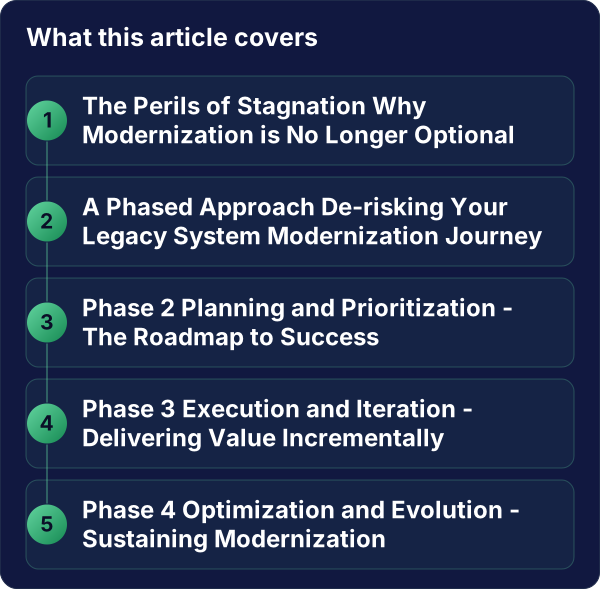
A Phased Approach: De-risking Your Legacy System Modernization Journey
A “big bang” approach to modernizing legacy systems is fraught with peril. A more prudent strategy involves a phased, iterative process that allows for continuous learning, adaptation, and risk mitigation. This approach ensures that business operations remain stable while new, modern capabilities are progressively introduced.
Phase 1: Assessment and Strategy Definition
This foundational phase is critical for setting the right direction and ensuring buy-in across the organization.
H3: Comprehensive System Audit
The first step is to conduct a thorough audit of your existing legacy systems. This involves:
- Inventory and Mapping: Documenting all existing systems, their dependencies, functionalities, and data flows. This provides a clear picture of the current landscape.
- Business Value Assessment: Evaluating the criticality of each system to core business operations and its contribution to strategic objectives.
- Technical Debt Analysis: Quantifying the extent of technical debt, including code complexity, lack of documentation, and outdated technologies.
- Risk Identification: Pinpointing specific risks associated with each system, such as security vulnerabilities, performance bottlenecks, or single points of failure.
H3: Defining Modernization Goals and Objectives
Based on the audit, clearly define what “modernization” means for your organization. This involves setting SMART (Specific, Measurable, Achievable, Relevant, Time-bound) goals. Examples include:
- Improve system performance by 30% within 18 months.
- Reduce operational costs associated with system maintenance by 20% annually.
- Enable the integration of new AI-powered analytics features within 12 months.
- Enhance data security compliance to meet GDPR/CCPA standards by Q4.
H3: Selecting the Right Modernization Strategy
There isn’t a one-size-fits-all solution. Common modernization strategies include:
- Rehosting (Lift and Shift): Moving applications to a new environment (e.g., cloud) with minimal changes. This offers quick wins in terms of infrastructure cost savings and agility but doesn’t address underlying architectural issues.
- Replatforming: Making minor changes to optimize applications for a new platform (e.g., moving from an on-premises database to a cloud-managed database). This offers a balance between speed and modernization benefits.
- Refactoring: Restructuring and optimizing existing code without changing its external behavior. This improves code quality, maintainability, and performance.
- Rearchitecting: Fundamentally altering the architecture of an application to leverage modern design patterns (e.g., microservices). This offers the greatest long-term benefits but requires significant effort.
- Rebuilding: Rewriting an application from scratch using modern technologies and architectures. This is typically reserved for systems that are beyond repair or no longer meet business needs.
- Replacing: Discarding the legacy system and adopting a new off-the-shelf solution.
The choice depends on the system’s criticality, technical debt, business requirements, and budget. A hybrid approach, combining different strategies for different systems, is often the most effective.
Phase 2: Planning and Prioritization - The Roadmap to Success
With a clear strategy, the next step is to create a detailed roadmap, prioritizing initiatives based on business value and technical feasibility.
H3: Prioritizing Modernization Initiatives
Not all legacy systems can be modernized simultaneously. Prioritization should be driven by:
- Business Impact: Systems that are critical to revenue generation, customer satisfaction, or regulatory compliance should be prioritized.
- Risk Mitigation: Systems with the highest security or operational risks should be addressed sooner.
- Quick Wins: Identifying initiatives that can deliver tangible benefits quickly can build momentum and demonstrate value early on.
- Dependencies: Understanding the interdependencies between systems is crucial to avoid creating new bottlenecks.
H3: Developing a Phased Roadmap with Milestones
A well-defined roadmap breaks down the modernization journey into manageable phases, each with clear milestones and deliverables. This roadmap should be iterative, allowing for adjustments based on learnings from previous phases.
Example Roadmap by Milestones & Quick Wins:
- Milestone 1: Foundation & Core Services (Months 1-6)
- Quick Win: Migrate a non-critical, high-maintenance reporting module to a cloud-based SaaS solution, reducing infrastructure overhead by 15%.
- Deliverable: Modernized core data access layer, enabling easier integration for future modules.
- Key Activity: Establish CI/CD pipelines for new development.
- Milestone 2: Key Business Functionality (Months 7-18)
- Quick Win: Replatform a customer-facing portal to a modern web framework, improving load times by 25% and user satisfaction scores.
- Deliverable: A modernized order processing module, enabling real-time inventory updates.
- Key Activity: Implement microservices for specific business functions.
- Milestone 3: Advanced Capabilities & Optimization (Months 19-36)
- Quick Win: Integrate an AI-powered recommendation engine into the customer portal, increasing conversion rates by 10%.
- Deliverable: Fully modernized customer relationship management (CRM) system.
- Key Activity: Decommission legacy systems that have been fully replaced.
H3: Building the Right Team and Governance
Successful modernization requires a skilled team and robust governance.
- Team Structure: Assemble a dedicated team comprising architects, developers (with expertise in modern technologies), QA engineers, project managers, and business analysts. Consider augmenting your internal team with external specialists for specific expertise.
- Governance Framework: Establish clear decision-making processes, communication channels, and change management protocols to ensure alignment and accountability.
Phase 3: Execution and Iteration - Delivering Value Incrementally
This phase involves the actual development and deployment of modernized components, focusing on iterative delivery and continuous feedback.
H3: Agile Development and DevOps Practices
Embrace agile methodologies to enable flexibility and rapid iteration. DevOps practices are crucial for streamlining the development, testing, and deployment process, ensuring faster delivery cycles and higher quality.
- Continuous Integration/Continuous Deployment (CI/CD): Automate build, test, and deployment processes to accelerate delivery and reduce manual errors.
- Automated Testing: Implement comprehensive automated testing strategies (unit, integration, end-to-end) to ensure code quality and stability.
H3: Incremental Deployment and Monitoring
Deploy modernized components in small, manageable increments. This allows for:
- Reduced Risk: If an issue arises, it’s contained to a smaller scope, making it easier to identify and fix.
- Faster Feedback Loops: Real-time user feedback can be incorporated into subsequent iterations.
- Business Continuity: Critical legacy systems continue to operate while new components are tested and validated.
Key Metrics to Track During Execution:
- Deployment Frequency: How often code is deployed to production.
- Lead Time for Changes: The time it takes from code commit to production deployment.
- Mean Time To Recovery (MTTR): How quickly services can be restored after a failure.
- Change Failure Rate: The percentage of deployments that result in a failure.
- System Uptime and Performance: Monitoring key performance indicators (KPIs) like response times, error rates, and resource utilization.
H3: Data Migration Strategy
Data is the lifeblood of any system. A robust data migration strategy is essential:
- Data Cleansing and Transformation: Ensure data accuracy and consistency before migrating.
- Phased Migration: Migrate data in stages, aligning with the modernization of specific modules.
- Validation: Rigorously validate migrated data to ensure integrity and completeness.
Phase 4: Optimization and Evolution - Sustaining Modernization
Modernization is not a one-time project but an ongoing process. This phase focuses on optimizing the new systems and fostering a culture of continuous improvement.
H3: Performance Tuning and Cost Optimization
Once modernized systems are in production, continuous monitoring and tuning are essential.
- Performance Monitoring: Utilize advanced monitoring tools to identify and address performance bottlenecks.
- Cost Management: Regularly review cloud infrastructure costs and optimize resource utilization to ensure cost-effectiveness.
H3: Embracing New Technologies and Innovation
With a modern, flexible architecture, you are now well-positioned to leverage emerging technologies.
- AI and Machine Learning: Integrate AI/ML for predictive analytics, automation, and personalized user experiences.
- Internet of Things (IoT): Connect devices and leverage IoT data for new insights and operational efficiencies.
- Data Analytics: Implement advanced analytics platforms to gain deeper business intelligence.
H3: Decommissioning Legacy Systems
As modernized components prove their stability and value, strategically decommission the old legacy systems. This not only reduces complexity and maintenance costs but also frees up valuable resources and eliminates security risks associated with outdated technology.
Checklist for Successful Legacy System Modernization
To ensure a smooth and successful legacy system modernization journey, consider the following checklist:
- [ ] Comprehensive Audit: Have you thoroughly documented all legacy systems, their dependencies, and business value?
- [ ] Clear Goals: Are your modernization goals SMART and aligned with business objectives?
- [ ] Strategy Selection: Have you chosen the most appropriate modernization strategy (rehost, replatform, refactor, rearchitect, rebuild, replace) for each system?
- [ ] Prioritized Roadmap: Is there a clear, phased roadmap with defined milestones and quick wins?
- [ ] Dedicated Team: Do you have the right internal and/or external expertise in place?
- [ ] Robust Governance: Are decision-making processes, communication channels, and change management protocols established?
- [ ] Agile & DevOps: Are agile development and DevOps practices being leveraged for efficient delivery?
- [ ] Incremental Deployment: Are you deploying modernized components in small, manageable increments?
- [ ] Comprehensive Monitoring: Are you actively monitoring system performance, security, and user experience?
- [ ] Data Migration Plan: Is there a detailed and validated plan for data migration?
- [ ] Continuous Optimization: Are processes in place for ongoing performance tuning and cost optimization?
- [ ] Innovation Strategy: Is there a plan to leverage the new modern architecture for future innovation?
- [ ] Decommissioning Plan: Is there a clear strategy for safely decommissioning legacy systems?
Conclusion: Transforming Your Business with Modernization
The journey of legacy system modernization is a strategic imperative for any organization looking to thrive in the digital age. By adopting a phased, risk-mitigated approach, businesses can systematically transform their outdated infrastructure into agile, scalable, and innovative platforms. This not only reduces operational costs and security risks but also unlocks new opportunities for growth, competitive advantage, and enhanced customer experiences.
At Alken, we understand the complexities and challenges inherent in legacy system modernization. Our team of experienced B2B software specialists is dedicated to helping product leaders, CTOs, and technology teams navigate this critical transition. We provide tailored strategies, expert guidance, and hands-on execution to ensure your modernization efforts are successful, delivering tangible business value and setting the stage for future innovation.
Ready to transform your legacy systems and unlock your business’s full potential?
Contact us today at info@alken.dev to discuss your modernization strategy.