MVP vs full product: how to scope your first software release
How to decide what goes in and what stays out of the first version of a software product. Practical criteria for scoping an MVP without compromising viability.
MVP vs full product: how to scope your first software release
“MVP” is one of the most misunderstood terms in digital product development. For some it means “a buggy version we ship fast.” For others, “a complete product we call an MVP to justify the timeline.” Neither interpretation is correct.
A real MVP is the smallest version of a product that allows you to validate the central business hypothesis with real users. It is not a prototype, not an unfinished product, and not an excuse to ship something that does not work.
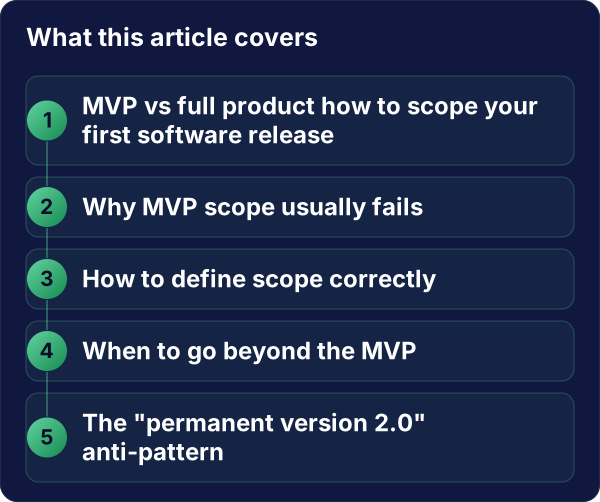
Why MVP scope usually fails
The most common problems when scoping an MVP:
Scope too wide: The team tries to replicate everything the product should eventually have. The MVP takes 12 months instead of 3, the market shifts, and the initial hypotheses are already irrelevant.
Scope too narrow: The MVP is so minimal it cannot generate real value for any user. There is no learning because nobody wants to use it.
No clear hypothesis: Scope is defined by features (“we want X, Y and Z”) rather than by the question to be answered (“will users pay to solve this problem with this solution?”).
How to define scope correctly
1. Start from the hypothesis, not the backlog
Before writing any functional requirements, define the hypothesis you want to validate:
“We believe that [user segment] will pay [price] to [solve this problem] because [reason].”
Everything that enters the MVP must be necessary to validate or refute that hypothesis. If a feature does not contribute to the validation, it does not go into the first release.
2. Separate the product from the business operations
Many features that look like product features are actually business operations: billing, onboarding flows, system notifications. In an MVP, these can often be handled manually or with temporary external tools (Stripe, Typeform, manual email). The product itself can be much smaller than it first appears.
3. Use impact mapping as a filter
For each proposed feature, ask:
- What user behaviour changes if we include this?
- How will we know if that change is positive?
- Is there a simpler way to validate the same thing?
If there is no clear answer to the first question, the feature should not enter the MVP.
4. Define success metrics before launching
An MVP without metrics produces no useful learning. Define before launch:
- The activation metric (when has a user achieved value?)
- The retention metric (do they come back?)
- The conversion metric if there is a business model (do they pay?)
These metrics are what determine whether the MVP has validated or invalidated the hypothesis.
When to go beyond the MVP
Once the MVP validates the central hypothesis, subsequent iterations expand scope deliberately. This is not about “adding everything that was cut” — it is about answering the next most important business question.
The cycle is:
- Hypothesis → 2. Minimum viable build → 3. Learning → 4. Decision → 5. Next iteration
Each cycle can last 2–8 weeks depending on technical complexity and user acquisition speed.
The “permanent version 2.0” anti-pattern
One of the most destructive anti-patterns: the team launches the MVP, collects feedback, but never decides what to prioritise. The backlog grows indefinitely, the product does not evolve coherently, and technical debt accumulates because “temporary” parts that nobody wanted to refactor.
The solution is simple but requires discipline: after each learning cycle, the team sits down to decide which business question to answer next — and that defines the scope of the next release.
Criteria for deciding what enters the MVP
A practical checklist:
- Is this feature required for the user to achieve the core value of the product?
- Without this feature, can the MVP still validate the main hypothesis?
- Is there no manual or temporary workaround that replaces it?
- Is the cost of including it now lower than the cost of not validating the hypothesis?
If all answers are “yes,” the feature goes in. If any is “no,” it can probably wait.
Conclusion
A good MVP is not the smallest product possible — it is the smallest product capable of producing real learning. That requires defining the hypothesis first, building only what is needed to validate it, and measuring results with pre-defined metrics.
MVP scope is as much a business decision as a technical one. Getting it right in the first iteration makes the difference between a project that learns and adjusts, and one that builds for months without knowing whether it is heading in the right direction.
Working on the scope definition of a new product or feature? Alken works in custom software development from the discovery phase, helping teams define the right scope before writing the first line of code.